Most explanations of egg freezing describe the medical steps: stimulation, retrieval, vitrification. Useful, but it does not tell you what the two weeks actually look like from where you are sitting. How many clinic visits. How many days off work. When you will feel bloated. What happens on retrieval morning. This article walks through the process as a patient experiences it, day by day.
If you are still deciding whether to do it at all, our articles on egg freezing and the best age to freeze your eggs cover that decision. This one assumes you have decided and want to know what you are signing up for.
The Whole Thing in One Line
From the first consultation to retrieval is usually two to six weeks, depending on where you are in your cycle when you start. The active part, once injections begin, is roughly two weeks. You will visit the clinic four to six times. You will need one day off for the retrieval itself.
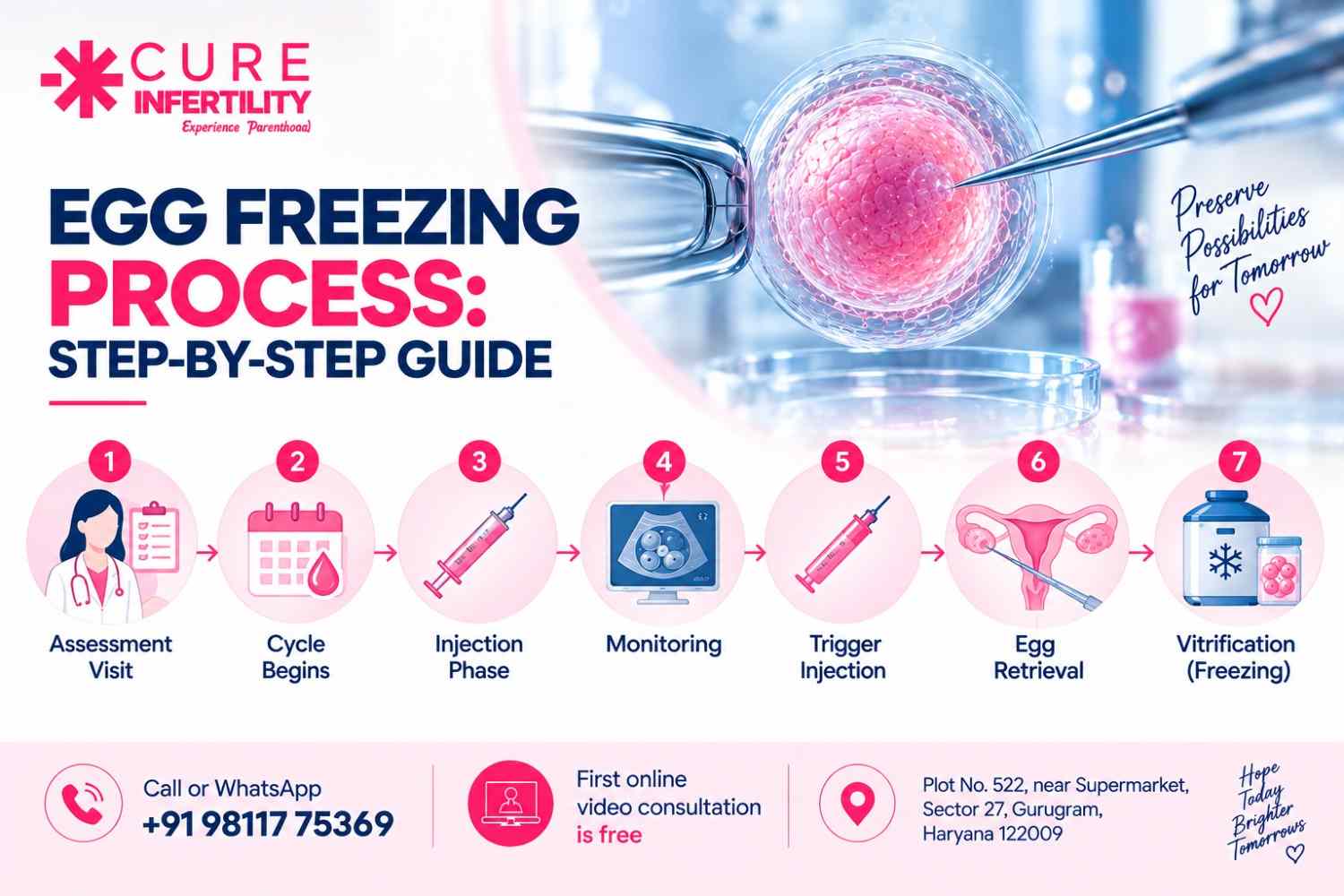
Before You Start: The Assessment Visit
The first appointment is about establishing what you have to work with, and it is the visit that should shape everything else.
Expect blood tests for AMH, FSH, estradiol, thyroid function and prolactin, plus infectious disease screening, which is a regulatory requirement before anything is stored. You will also have a transvaginal ultrasound for an antral follicle count.
Your AMH and antral follicle count together predict how many eggs you are likely to produce, which determines your medication dose and, importantly, whether one cycle is realistic or whether you should plan for two from the start. Our article on the AMH test explains what those numbers mean.
This is the point to ask the practical questions: how many eggs am I likely to get, how many cycles is that likely to mean, what is the total cost including annual storage, and what happens if the response is poor.
Day 1 to 2: The Cycle Begins
Stimulation starts in the first days of your period, typically day 2 or 3. Some protocols include a preparatory phase with the pill beforehand, which is used to control timing rather than for any clinical necessity.
You will have a baseline scan and blood test to confirm the ovaries are quiet and ready. Then you collect your medications and, ideally, have a teaching session where someone demonstrates the injection technique. Ask for this if it is not offered, because the first injection is considerably easier when you have watched someone do it.
Day 2 to 10: The Injection Phase
This is the longest stretch and the part people worry about most in advance.
You will give yourself one or two subcutaneous injections daily, into the abdomen or upper thigh, using a very fine short needle. Most preparations come as pre-filled pens. Around day five or six, a second medication is usually added to stop your body releasing the eggs early.
Timing matters but is not rigid for the daily injections. Most clinics ask you to take them within a consistent window each evening. Set an alarm.
What it feels like. The injection itself is a brief sting. What builds over the week is bloating and a sense of abdominal fullness as the ovaries enlarge, along with breast tenderness, mood changes, tiredness and sometimes headaches. By day eight or nine most women feel noticeably bloated. Loose clothing helps more than you would expect.
Monitoring. Expect three to four visits during this phase, usually every two to three days, each involving a short ultrasound to measure follicle growth and a blood test. These appointments are quick, often twenty minutes, but they are usually early morning and they are not optional, since your dose is adjusted based on what they show.
Work and life. Most women continue working normally. The friction is the monitoring appointments rather than the symptoms. Exercise should be gentle from around day six, and high-impact activity is avoided once the ovaries are enlarged, because of the small risk of ovarian torsion. Alcohol is best avoided. Travel during this window is impractical given the scan schedule.
Around Day 10 to 12: The Trigger
When the follicles reach the right size, you are given a trigger injection to complete final maturation of the eggs.
This is the one injection where timing is exact, not approximate. Retrieval is scheduled 34 to 36 hours later, and the whole cycle depends on this interval. You may be told to take it at an unusual hour, such as 11pm or 1am. Take it exactly then. Set two alarms.
After the trigger, no further stimulation injections are given. You have roughly a day and a half of waiting.
Retrieval Day
Plan for the full day, even though the procedure itself is short.
You will be asked to fast from midnight and to arrive a couple of hours before the scheduled time. Bring your ID and paperwork, wear comfortable clothes, remove nail polish and jewellery, and arrange for someone to take you home, since you cannot drive after sedation.
The procedure takes around 20 to 30 minutes. Under sedation, a needle is passed through the vaginal wall under ultrasound guidance to aspirate fluid from each follicle. You will not feel it and will not remember it.
You wake in recovery and stay for one to two hours. Cramping similar to period pain, some bloating and light spotting are normal. Most women go home within a few hours and feel reasonably normal by the next day, though some take two days.
The number you get told. Before you leave, you will usually be told how many eggs were retrieved. This is not the number that gets frozen. Only mature eggs can be vitrified, and typically a proportion of those retrieved are immature. The final count comes later the same day or the next morning, and it is normal for it to be lower than the retrieval number. Knowing this in advance saves an unnecessary afternoon of worry.
Freezing and Storage
Mature eggs are vitrified within hours of retrieval, an ultra-rapid freezing method that prevents ice crystals forming, and stored in liquid nitrogen. Survival rates on thawing are high with modern vitrification, though not universal.
You will sign consent covering storage duration, what happens if fees lapse, and what happens to the eggs in various circumstances. Read this properly rather than signing at the desk on your way out. Storage fees are annual and ongoing, and it is worth knowing how you will be contacted for renewal.
The Days After
Bloating often peaks one to three days after retrieval rather than immediately, which surprises people. Your next period usually arrives within one to two weeks and may be heavier than usual.
Contact the clinic urgently if you have rapid weight gain over a few days, severe or worsening abdominal pain, significant swelling, breathlessness, persistent vomiting or markedly reduced urine output. These can indicate ovarian hyperstimulation syndrome, which is uncommon with modern protocols but needs prompt attention.
If You Need a Second Cycle
Many women do, particularly those over 35 or with lower ovarian reserve. This is not a sign that something went wrong.
A second cycle can usually start after one intervening period, so back-to-back cycles are possible within about two months. Eggs from multiple cycles are simply stored together. If your first cycle yielded fewer eggs than predicted, ask specifically whether the protocol will change, since repeating an identical approach that underperformed rarely produces a different result.
When You Come Back to Use Them
Worth knowing now, because it affects how you think about the storage.
Eggs are thawed and fertilised in the laboratory using ICSI, which is standard with frozen eggs because vitrification slightly hardens the outer layer of the egg. The resulting embryos are cultured and transferred through a standard IVF process, usually with the uterine lining prepared in a separate cycle.
Losses occur at each stage: thawing, fertilisation, embryo development and implantation. This is why the number of eggs you bank matters so much, and why the figure quoted at retrieval is not the same as a number of chances.
A Realistic Checklist Before You Start
- Have you had an AMH and antral follicle count, and been told what yield to expect?
- Do you know whether one cycle is realistic for you, or whether two should be planned?
- Do you know the total cost, including annual storage?
- Have you booked the retrieval day off work and arranged transport home?
- Have you had a proper injection teaching session?
- Do you know who to contact out of hours?
- Have you read the storage consent rather than skimmed it?
You can see the full range of treatment options here.
You can book a free consultation with Dr. Rashmi Agrawal at the Sector 27, Gurugram clinic for an ovarian reserve assessment and a plan specific to your situation, read more about her background and approach, or check the FAQ page.
FAQs
How long does the egg freezing process take?
Around two to six weeks from first consultation to retrieval, depending on where you are in your cycle. The active phase, once injections start, is roughly two weeks.
How many clinic visits are needed?
Typically four to six: a baseline scan, three or four monitoring visits during stimulation, and retrieval day itself.
How many days off work will I need?
Usually just retrieval day, plus the following day if you recover slowly. Monitoring appointments are short but are generally early morning.
Does egg retrieval hurt?
No. It is done under sedation, so you will not feel it or remember it. Cramping and bloating afterwards are normal and settle within a few days.
Why are fewer eggs frozen than retrieved?
Only mature eggs can be vitrified. A proportion of eggs retrieved are immature and cannot be frozen, so the final count is usually lower than the number quoted immediately after the procedure.
Can I exercise during stimulation?
Gentle activity is fine early on. High-impact exercise is avoided from around the middle of stimulation, since enlarged ovaries carry a small risk of torsion.
What if I miss an injection or take it late?
Contact the clinic rather than adjusting the dose yourself. Timing is most critical for the trigger injection, where the interval before retrieval determines the outcome of the cycle.
How soon can I do a second cycle?
Usually after one intervening period, so two cycles within about two months is feasible. Ask whether the protocol will be adjusted if the first cycle underperformed.
References
- Practice Committees of the American Society for Reproductive Medicine and the Society for Assisted Reproductive Technology. Evidence-based outcomes after oocyte cryopreservation for donor oocyte IVF and planned oocyte cryopreservation: a guideline. https://www.asrm.org/practice-guidance/practice-committee-documents/evidence-based-outcomes-after-oocyte-cryopreservation-for-donor-oocyte-in-vitro-fertilization-and-planned-oocyte-cryopreservation-a-guideline-2021/
- Planned oocyte cryopreservation: the state of the ART. Reproductive BioMedicine Online. https://www.rbmojournal.com/article/S1472-6483(23)00466-2/fulltext