The honest answer is that the best age to freeze your eggs is almost certainly younger than the age you will actually be when you decide to do it. That gap is the central problem with egg freezing, and no clinic marketing addresses it. This article gives you the real numbers by age, so you can make the decision with arithmetic rather than hope.
For the full picture of what the procedure involves, our complete guide to egg freezing covers the process, risks and practicalities. This article is about timing alone.
Why Age Is the Entire Question
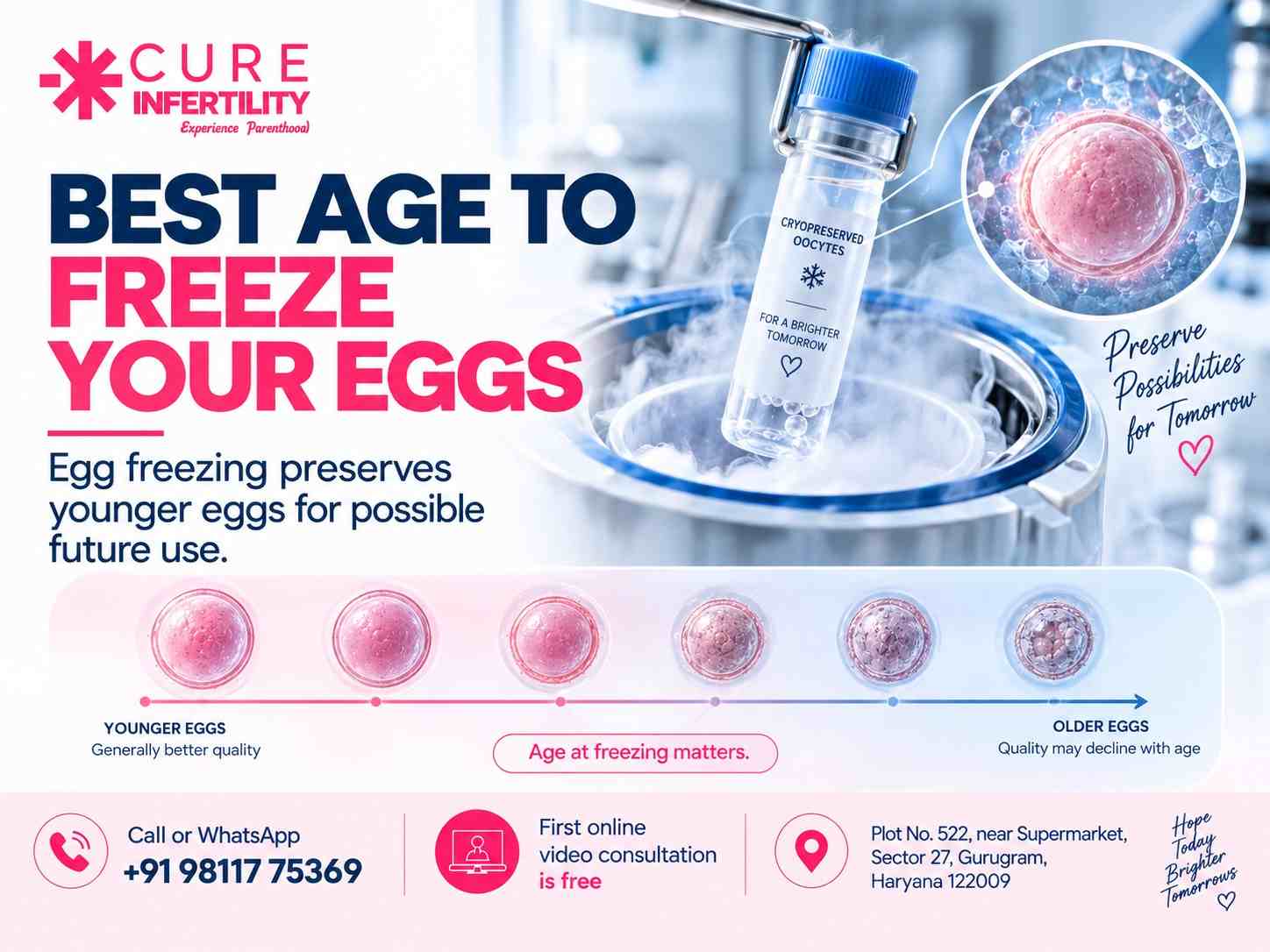
Egg freezing preserves eggs at the quality they have on the day they are retrieved. That is the whole premise. Freeze at 31 and you are storing 31-year-old eggs, whatever age you use them at.
Age drives two things at once, and they compound.
Quantity. Younger ovaries yield more eggs per stimulation cycle, so fewer cycles are needed to bank a given number.
Quality. The proportion of chromosomally normal eggs falls with age. This is why older eggs are worth less per egg, and why the number you need rises so steeply.
The result is that a woman freezing at 40 needs several times as many eggs as a woman freezing at 32 for the same chance of a baby, while producing fewer per cycle. The maths moves against you from both directions simultaneously.
The Numbers, By Age
The widely used counselling model estimates the number of mature eggs needed for roughly a 70 percent chance of at least one live birth. Different models give slightly different figures, but the shape is consistent.
| Age at freezing | Mature eggs needed for ~70% chance of one live birth | Realistic assessment |
|---|---|---|
| Under 35 | Around 10 to 15 | Usually achievable in one or two cycles |
| Age 35 to 37 | Around 15 to 20 | Typically one to two cycles |
| Age 38 | Around 20 | Often two or more cycles |
| Age 40 | Around 35 | Usually three or more cycles |
| Age 42 | Around 55 | Rarely achievable in practice |
Read the right-hand column carefully. The numbers at 40 and 42 are not theoretical. They are the reason egg freezing at those ages often does not deliver what women expect, since banking 35 or 55 mature eggs requires multiple full cycles, each with its own cost and physical demand.
Real-world outcome data supports the same pattern. In one large centre's series of women who returned to use their frozen eggs, 51 percent of those who had frozen under age 38 achieved a live birth, rising to 70 percent among those who thawed at least 20 mature eggs. For women who had frozen at 38 to 40 the figure was 34 percent, and for those who froze at 41 or older, 23 percent.
So What Is the Best Age?
Late twenties to early thirties is biologically optimal. Highest yield per cycle, highest proportion of normal eggs, fewest cycles needed. The drawback is that many women at this age do not yet know whether they will need the eggs at all, and a meaningful proportion never use them.
Early to mid thirties, roughly 32 to 35, is the practical sweet spot. Egg quality is still good, yields are still reasonable, and by this age most women have a clearer sense of whether their circumstances are likely to require it. If there is a single answer to the question, this is it.
Age 36 to 37 still works well. The decline has begun but is not steep. This is a reasonable window and a common one.
Age 38 to 40 is where returns fall sharply. Egg freezing is still worth considering, particularly with good ovarian reserve, but expectations need adjusting and multiple cycles should be planned from the outset rather than discovered along the way.
Over 40, the honest conversation changes. The number of eggs required is high, yields are low, and for many women in this position, attempting pregnancy now, or considering embryo freezing or donor eggs, is a more realistic route than banking eggs for later. A centre willing to take your money for a single cycle at 42 without explaining this is not serving you well.
The Gap Between Optimal and Actual
Here is the statistic that should shape your thinking. In published series, the median age at which women actually freeze their eggs is around 38, the median gap before they return to use them is around four years, and the median age at use is around 42.
In other words, most women freeze their eggs several years after the point at which it works best, and then wait several more years before using them.
The reason is not ignorance. It is that the age at which egg freezing works best is the age at which most women feel least certain they need it, and least able to justify the cost. By the time the need feels real, the biology has moved.
If you are reading this in your early thirties and wondering whether it is too early, that hesitation is exactly the pattern described above.
Ovarian Reserve Changes the Answer
Age is the strongest factor, but it is not the only one. Two women of 33 can have quite different prospects.
Your AMH and antral follicle count determine how many eggs you are likely to produce per cycle, which changes how many cycles you would need. Low reserve at a young age argues for acting sooner, not for giving up, since egg quality remains age-appropriate even when quantity is reduced. Our articles on the AMH test and low AMH and pregnancy explain why that distinction matters.
Other factors that shift the timing: a family history of early menopause, endometriosis or endometriomas, planned ovarian surgery, and any upcoming treatment that could damage ovarian reserve.
Medical Reasons Override the Ideal Window
Everything above applies to elective freezing. Where there is a medical indication, the timing is dictated by circumstance.
Before chemotherapy or radiotherapy, egg freezing happens as soon as it can be arranged, regardless of the calendar. The same applies before surgery that may reduce ovarian tissue, and in some autoimmune conditions requiring drugs that affect fertility. In these situations the question is not what age is best, but how quickly it can be organised without delaying necessary treatment.
Should You Freeze Embryos Instead?
If you have a partner and no reason to delay fertilisation, embryo freezing has better established outcomes, because embryos have already cleared the fertilisation and early development hurdles. You know more about what you have stored.
The trade-off is autonomy. Frozen embryos involve a partner's genetic material and consent, which becomes complicated if the relationship ends. Frozen eggs remain yours alone. This is a genuine decision, not a technicality, and it is worth thinking through before the cycle rather than after.
What Freezing at the Right Age Does Not Guarantee
Even at the optimal age, this is an improvement in odds, not insurance.
Eggs are lost at thawing, at fertilisation, at embryo development and at implantation. When you eventually use them, the cycle follows the standard IVF route with ICSI, which is used because vitrification slightly hardens the outer layer of the egg. Success then depends on everything else in the picture, including your uterus and your partner's sperm at that time.
A meaningful proportion of women who freeze eggs never use them, either because they conceived naturally or because their circumstances changed. That is not a failure. It is the nature of an option you buy in advance.
What to Do Before Deciding
Start with an ovarian reserve assessment: AMH and an antral follicle count. That tells you what you would actually be working with and how many cycles you would realistically need. Without it, any discussion of timing is generic.
Then ask, specifically for your age and reserve: how many eggs would I be aiming for, how many cycles is that likely to take, what is the total cost including storage, and what is the realistic chance this gives me?
You can see the full range of treatment options here.
You can book a free consultation with Dr. Rashmi Agrawal at the Sector 27, Gurugram clinic for an ovarian reserve assessment and a realistic picture for your age, read more about her background and approach, or check the FAQ page.
FAQs
What is the best age to freeze your eggs?
Biologically, the late twenties to early thirties. Practically, around 32 to 35 offers the best balance of egg quality, yield per cycle and knowing whether you are likely to need them.
Is 35 too late to freeze eggs?
No. Outcomes at 35 remain good. It is the point at which the decline becomes noticeable, which is a reason to act rather than to delay further.
Is 40 too late to freeze eggs?
Not impossible, but returns fall sharply. At 40 the number of eggs needed for a reasonable chance is high, and yields per cycle are lower, so multiple cycles should be planned. For some women, other routes are more realistic.
How many eggs do I need to freeze?
It depends on age. Roughly 10 to 15 mature eggs under 35, around 20 at 38, and considerably more at 40 and beyond for a similar chance of one live birth.
Does freezing eggs younger guarantee a baby later?
No. It preserves egg quality at that age and improves your odds, but losses occur at thawing, fertilisation, embryo development and implantation.
How long can frozen eggs be stored?
Vitrification effectively halts biological activity, so eggs remain viable for many years. Practical limits come from local regulation rather than the biology.
Should I freeze eggs or embryos?
Embryo freezing has better established outcomes but requires a partner's genetic material and consent. Egg freezing preserves your independence. The right choice depends on your circumstances rather than the biology alone.
Does low AMH mean I should freeze eggs sooner?
It generally argues for acting sooner rather than later, since reserve declines and does not recover. It also means planning for lower yields per cycle. It does not mean egg freezing will not work.
References
- Practice Committees of the American Society for Reproductive Medicine and the Society for Assisted Reproductive Technology. Evidence-based outcomes after oocyte cryopreservation for donor oocyte IVF and planned oocyte cryopreservation: a guideline. https://www.asrm.org/practice-guidance/practice-committee-documents/evidence-based-outcomes-after-oocyte-cryopreservation-for-donor-oocyte-in-vitro-fertilization-and-planned-oocyte-cryopreservation-a-guideline-2021/
- Goldman RH, et al. Predicting the likelihood of live birth for elective oocyte cryopreservation: a counseling tool for physicians and patients. Human Reproduction. https://academic.oup.com/humrep/article/32/4/853/2968357
- Planned oocyte cryopreservation: the state of the ART. Reproductive BioMedicine Online. https://www.rbmojournal.com/article/S1472-6483(23)00466-2/fulltext