IVF Success Rate by Age: What Are Your Chances at 30, 35 and 40?
Understand how age can affect IVF success rates and what your chances may look like at 30, 35 and 40. Learn about the factors that influence IVF outcomes.
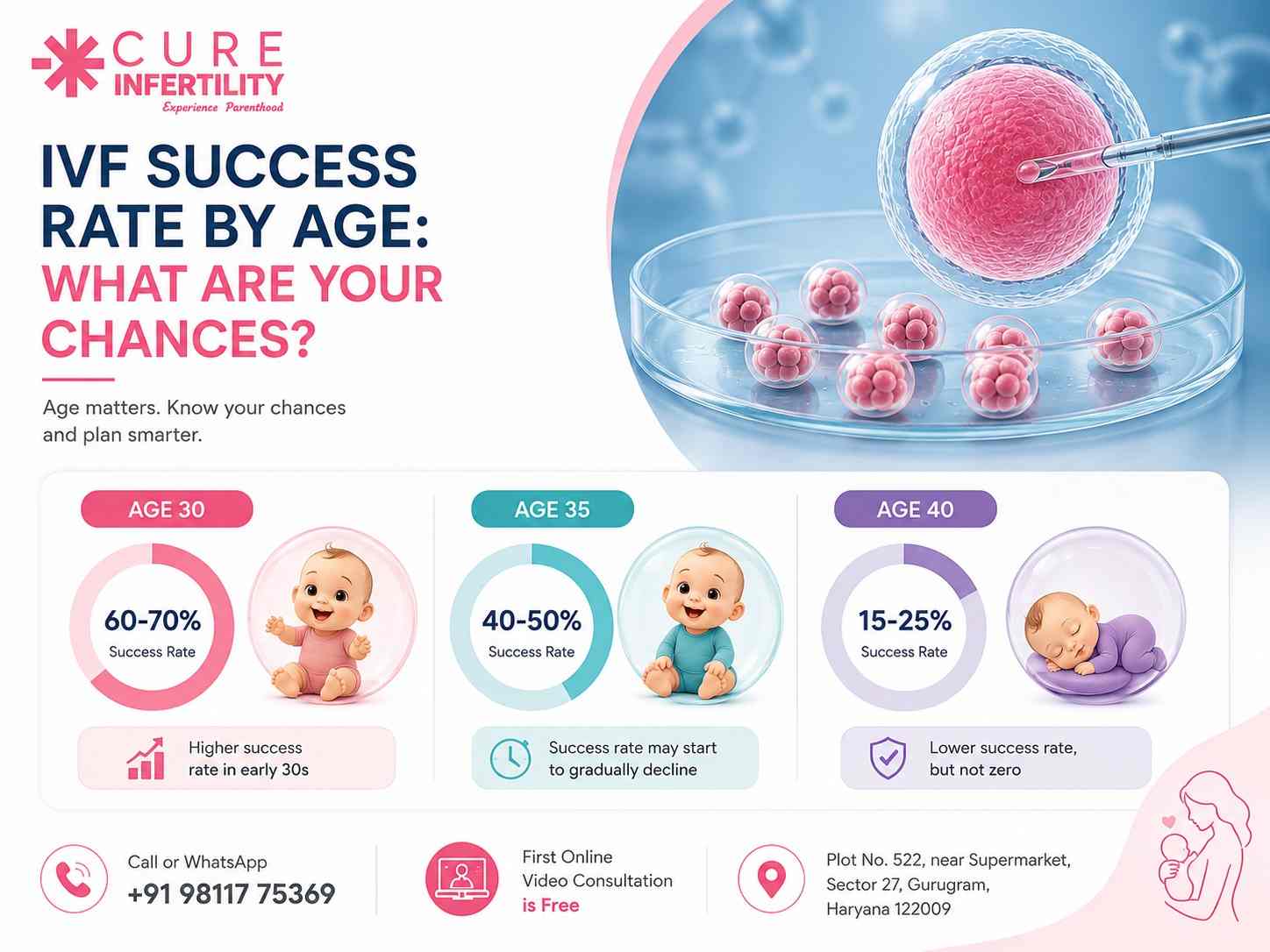
Age is the single strongest predictor of IVF success, more than almost any other factor. That's not a comfortable thing to hear, but knowing the real numbers helps you make decisions with clarity instead of guesswork. Here's what the chances actually look like at 30, 35 and 40, and what shifts them in your favour.
Why Age Affects IVF Success More Than Anything Else
Women are born with a fixed number of eggs, and both the quantity and the quality of those eggs decline with time. Quantity is measurable through ovarian reserve testing, and it determines how many eggs can be retrieved in a stimulation cycle. Quality is the harder part: as eggs age, the rate of chromosomal abnormalities (aneuploidy) rises steadily, and abnormal embryos either fail to implant or result in early miscarriage.
This is why two women can produce the same number of eggs in a cycle and still have very different outcomes. It isn't about how many eggs you get. It's about how many of them are chromosomally normal.
IVF Success Rates by Age: The Honest Numbers
These are broad ranges drawn from international registry data for live birth per embryo transfer using a woman's own eggs. Your individual numbers depend on your diagnosis, ovarian reserve, sperm quality, uterine health and the lab you're treated at, so treat these as orientation, not prediction.
Under 35: roughly 40 to 50 percent live birth rate per transfer. This is the strongest bracket, largely because a higher proportion of eggs are chromosomally normal.
Around 35 to 37: roughly 30 to 40 percent. Still solid, but this is where the curve begins to bend.
Around 38 to 40: roughly 20 to 30 percent. Egg quality decline becomes more pronounced, and more cycles are often needed to get a viable embryo.
Age 41 to 42: roughly 10 to 15 percent per transfer.
Over 42: typically under 5 to 10 percent with a woman's own eggs, which is why donor eggs are discussed more openly in this bracket.
Two things worth flagging: cumulative success across multiple cycles is meaningfully higher than the per-cycle number, and success rates using donor eggs stay high regardless of the recipient's age, because they track the donor's age instead.
Reading Success Rate Claims Critically
Clinics report success in different ways, and the framing can change the number dramatically. Watch for:
- Per cycle started versus per embryo transfer: per transfer looks higher, because cycles that were cancelled or produced no viable embryo drop out of the denominator
- Pregnancy rate versus live birth rate: pregnancy rate includes pregnancies that later miscarry, so it always looks better
- Age-grouped versus overall averages: a clinic's overall number tells you about their patient mix as much as their skill
- Patient selection: centres that decline complex cases will naturally post better numbers
If a clinic quotes a figure without specifying which of these it refers to, ask.
Understanding Your Own Odds, Not the Average
The published numbers are averages across large populations. Yours are shaped by your specific situation, and a proper workup is what turns a national statistic into a personal estimate. The main inputs are your AMH and antral follicle count (a measure of ovarian reserve), your partner's semen analysis, uterine health, and how you've responded to any previous cycles. Underlying conditions like endometriosis, fibroids or PCOS matter too. This is exactly what a first consultation is for, and a free consultation will give you a written, realistic picture rather than a generic figure.
What Can Improve Your Chances
Genetic testing of embryos: PGT (preimplantation genetic testing) screens embryos for chromosomal abnormalities before transfer. Since aneuploidy is the primary driver of age-related IVF failure, this becomes more relevant with increasing age, and can reduce time spent on transfers that were never going to work.
Addressing male factor properly: sperm quality contributes to embryo quality. Where there's significant male factor infertility, ICSI injects a single healthy sperm directly into each egg. For men with azoospermia, surgical sperm retrieval techniques like PESA, TESA and Micro TESE can extract sperm directly from the reproductive tract.
Fixing structural issues first: polyps, fibroids, adhesions or endometriosis can quietly reduce implantation chances. Hysteroscopy and laparoscopy can diagnose and treat these in a single sitting before an IVF cycle begins.
Investigating repeated implantation failure: if good-quality embryos have failed to implant more than once, an endometrial biopsy and ERA test can identify whether the implantation window is shifted, and screen for hidden inflammation.
Lifestyle factors: stopping smoking, moderating alcohol, and reaching a healthier weight range all have measurable effects. They won't reverse age-related decline, but they remove avoidable drag on your odds.
Not delaying: this is the one that matters most, and the one people most often postpone. Every year of waiting reduces the odds in a way no protocol fully compensates for.
Not Everyone Needs IVF
It's worth stating plainly: a large share of couples conceive with simpler treatments. If ovulation is the issue, ovulation induction and cycle monitoring is often all that's needed, particularly for younger couples with PCOS. For unexplained infertility or mild male factor, IUI is usually the first-line option. IVF is recommended when the diagnostic picture genuinely calls for it, not by default. You can see the full range of treatment options here.
When to Get Evaluated
If you're under 35 and have been trying for 12 months without success, or 35 and over and have been trying for 6 months, it's time for an evaluation. Seek help sooner if you have irregular periods, known PCOS or endometriosis, previous pelvic surgery, recurrent miscarriage, or a known male factor issue. Given how much age affects outcomes, the cost of getting evaluated early is low and the cost of waiting is not.
You can book a free consultation with Dr. Rashmi Agrawal at the Sector 27, Gurugram clinic, or read more about her background and approach. Common questions are also answered on the FAQ page.
FAQs
What is the success rate of IVF at age 30?
Women under 35 generally see live birth rates of around 40 to 50 percent per embryo transfer using their own eggs, though individual odds depend on ovarian reserve, sperm quality and any underlying conditions.
Is 35 too late for IVF?
No. Success rates at 35 remain good, typically in the 30 to 40 percent range per transfer. It's the point where the decline starts becoming noticeable, which is a reason to act rather than a reason to give up.
What are the chances of IVF working at 40?
At 40, live birth rates per transfer are generally around 20 to 25 percent with a woman's own eggs, dropping further after 42. Multiple cycles and genetic testing of embryos are more commonly discussed at this stage.
Does IVF success depend on the number of eggs retrieved?
Partly, but egg quality matters more than quantity. A younger woman with fewer eggs often has better odds than an older woman with more, because a higher proportion of her eggs are chromosomally normal.
Do success rates improve with more IVF cycles?
Cumulative success across several cycles is meaningfully higher than the rate for any single cycle. Many couples who conceive through IVF do so on a second or third attempt rather than the first.
Does using donor eggs change the age effect?
Yes. Donor egg success rates track the donor's age rather than the recipient's, which is why they remain high even for older recipients. Whether it's appropriate depends on your specific situation and is a decision to work through with your doctor.
Does male age affect IVF success too?
It has an effect, though a smaller and more gradual one than female age. Sperm quality does decline over time and can influence fertilisation and embryo quality, which is why a semen analysis is part of every complete workup.
Medically reviewed
Reviewed by Dr. Rashmi Agrawal — MBBS (Gold Medalist), MS OBGYN, FNB Reproductive Medicine. This article is general information, not a substitute for a consultation about your own reports.
Book Consultation