Endometrial Thickness for Embryo Transfer: What Is Ideal?
Learn what endometrial thickness is considered ideal for embryo transfer, how the uterine lining is measured, and which factors may affect implantation and IVF success.
Few numbers on an IVF scan report cause more anxiety than endometrial thickness. Women hear that the lining "must be 8mm," see a 6.8 on their report, and assume the cycle is over. Sometimes a thin lining genuinely matters. Often it is less decisive than it looks. This article explains what the measurement means, what thickness is generally considered good, why the number is a probability rather than a pass mark, and what can be done when the lining stays thin.
What the Endometrium Is and Why It Matters
The endometrium is the inner lining of the uterus, the tissue an embryo implants into. Each cycle it builds up under the influence of oestrogen, then is transformed by progesterone into a receptive state, and is shed as a period if no pregnancy occurs.
For implantation, the lining needs to be thick enough, well supplied with blood, and in the right phase of development at the moment the embryo arrives. Thickness is the easiest of those three to measure, which is partly why it gets so much attention.
How It Is Measured
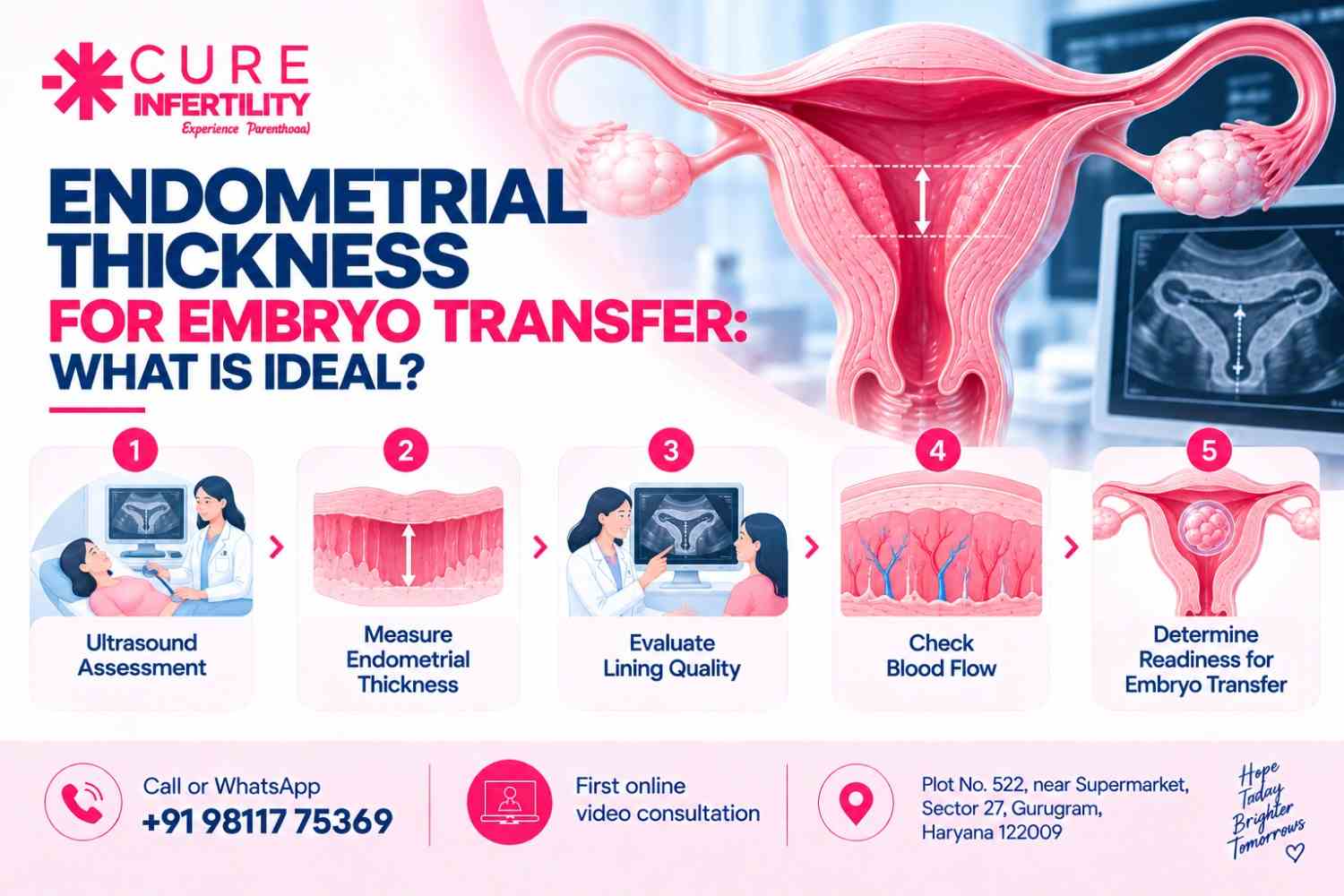
Endometrial thickness is measured on a transvaginal ultrasound, in millimetres, across the widest point of the lining in a lengthwise view of the uterus. The figure includes both layers of the lining, front and back.
Alongside the number, the scan also notes the pattern. Before progesterone starts, a healthy lining under oestrogen typically shows a trilaminar or "triple-line" appearance: three bright lines with darker bands between them. After progesterone, the lining becomes uniformly bright, which is normal and expected.
Measurement varies slightly between operators and machines, so differences of half a millimetre between scans are not meaningful.
What Is the Ideal Endometrial Thickness?
Most clinics aim for a lining of around 7 to 8mm or more before embryo transfer, with a trilaminar pattern before progesterone begins.
That target comes from large studies showing that pregnancy and live birth rates fall progressively as the lining gets thinner, particularly below about 7mm. One analysis of more than 40,000 embryo transfers found outcomes declined as thickness dropped below these thresholds in both fresh and frozen cycles, along with a higher rate of miscarriage in very thin linings.
Above roughly 8mm, there is no clear advantage to a thicker lining. A lining of 9mm is not meaningfully better than one of 8mm, and 12mm is not better than 10mm.
Why the Number Is Not a Pass or Fail
This is the most important point in the article, and it is often lost.
The relationship is a gradient, not a cliff. Chances fall gradually as the lining thins. There is no single number at which implantation becomes impossible, and pregnancies do occur with linings of 6mm and occasionally less.
Thickness alone is a weak predictor. A critical review of the research has pointed out that endometrial thickness, on its own, is a poor discriminator of which transfers will succeed, and that many studies in this area have methodological limitations. Most transfers with a normal lining still do not result in pregnancy, and some with a thin lining do.
The embryo matters more. A chromosomally normal embryo transferred into a 6.5mm lining may have better prospects than an abnormal embryo transferred into an 11mm lining. Our article on embryo quality and failed transfers covers why.
So a lining of 6.8mm is a reason for a discussion with your doctor, not an automatic reason to cancel.
Fresh Transfer Versus Frozen Transfer
This distinction changes how a thin lining is managed.
In a fresh IVF cycle, the timing is fixed by the egg retrieval. If the lining is thin on the day, there is no opportunity to extend preparation. The usual option is to freeze all embryos and transfer later in a cycle where the lining can be prepared properly.
In a frozen embryo transfer, the timing is flexible. If the lining is thin, oestrogen can be continued for longer, the dose or route can be changed, and the transfer is simply postponed until the lining is ready. This flexibility is one of the practical advantages of freeze-all strategies. Our article on frozen embryo transfer explains how the lining is prepared in each type of cycle.
What Causes a Thin Lining?
A thin lining is a sign, not a diagnosis. The cause determines what can be done.
Intrauterine adhesions (Asherman's syndrome). Scar tissue inside the uterus, most often after a previous D&C, particularly after a miscarriage or delivery, or after uterine infection or surgery. Scarred areas of lining do not respond properly to oestrogen. Periods may become noticeably lighter.
Genital tuberculosis. A significant and often silent cause in India. TB can damage the endometrium and the fallopian tubes, sometimes leaving a thin, poorly responsive lining. Our article on blocked fallopian tubes covers its effect on the tubes.
Chronic endometritis. Low-grade inflammation of the lining that causes no symptoms and is treatable with antibiotics.
Clomiphene. This ovulation medication has an anti-oestrogen effect on the lining and can thin it, especially over repeated cycles. Letrozole has less of this effect, which is one reason it is often preferred.
Low oestrogen, from poor ovarian response, reduced ovarian reserve or inadequate oestrogen dosing in a frozen cycle.
Reduced blood flow to the uterus, which can accompany age, fibroids or previous surgery.
Previous uterine surgery, including fibroid removal and caesarean section.
Sometimes no clear cause is found.
Investigating a Persistently Thin Lining
If the lining is thin in more than one cycle, it is worth looking for the cause rather than simply increasing medication.
Hysteroscopy is the key investigation. It looks directly at the uterine cavity, identifies adhesions, and allows them to be divided in the same sitting. A biopsy taken at the same time can detect chronic endometritis and, where suspected, genital tuberculosis. Our article on hysteroscopy before IVF explains when that is worthwhile.
A detailed history matters too: previous D&Cs, pelvic infections, TB exposure, and whether periods have become lighter over time.
How a Thin Lining Can Be Improved
Treat the underlying cause first. Dividing adhesions, treating chronic endometritis or treating tuberculosis addresses the problem directly. Nothing else is likely to work while a structural or inflammatory cause remains.
Extend or adjust oestrogen. In a frozen cycle, continuing oestrogen for longer, adjusting the dose, or changing the route, for example from tablets to patches or vaginal preparations, helps many women reach an adequate thickness.
Consider a natural cycle. Some women develop a better lining in a natural cycle with their own ovulation than in a medicated one.
Switch away from clomiphene if it is being used for ovulation induction. Our page on ovulation induction and cycle monitoring covers the alternatives.
Adjuvant treatments. A range of additional therapies are offered for thin endometrium, including sildenafil, low-dose aspirin, vitamin E, L-arginine, G-CSF and platelet-rich plasma (PRP). The evidence for these is limited, mostly from small studies, and none has been shown convincingly to improve live birth rates in the way that treating a specific cause can. Some are reasonable to try in selected cases after the basics have been addressed. If one is being recommended, it is fair to ask what evidence supports it in your situation and what it costs.
Lifestyle factors such as stopping smoking support uterine blood flow generally, though they will not by themselves overcome a significant problem.
When the Lining Does Not Improve
For a small number of women, the lining remains thin despite treating the cause and optimising preparation.
The options at that point are to proceed with transfer accepting somewhat lower odds, which can be a reasonable decision with good-quality embryos and full information, or to consider further specialist assessment. In rare cases, where the uterus genuinely cannot support a pregnancy, gestational surrogacy may be discussed within the framework of Indian law.
These are significant decisions that deserve unhurried discussion, not a decision made on a single scan.
Can the Lining Be Too Thick?
A thick lining by itself is rarely a problem for implantation. Very thick or irregular linings are, however, worth assessing for polyps or endometrial hyperplasia, particularly where there is irregular bleeding. A thick lining with a uniform, healthy appearance usually needs no action.
Thickness Is Only Part of Receptivity
A lining can be a perfect 9mm and still not be receptive if the embryo arrives at the wrong time. Receptivity depends on the timing of progesterone exposure as well as thickness. Where good-quality embryos have repeatedly failed to implant despite a normal lining, an endometrial biopsy and ERA test can check whether the implantation window is displaced. Our article on tests to consider after repeated IVF failure covers the wider workup.
Questions Worth Asking
- What is my lining thickness and pattern, and what threshold does the clinic use?
- If it is thin, should we postpone and extend preparation, or proceed?
- Has the cause been investigated, including hysteroscopy if it has been thin before?
- Could a natural cycle or a different oestrogen route help?
- If an adjuvant treatment is suggested, what evidence supports it?
You can read more on the IVF treatment page and see the full range of treatment options here.
You can book a free consultation with Dr. Rashmi Agrawal at the Sector 27, Gurugram clinic to review your scans and previous cycles, read more about her background and approach, or check the FAQ page.
FAQs
What is the ideal endometrial thickness for embryo transfer?
Most clinics aim for around 7 to 8mm or more, with a triple-line pattern before progesterone starts. Above about 8mm, a thicker lining does not clearly improve the chance of pregnancy.
Can I get pregnant with a 6mm lining?
Yes, it is possible, though the chance is lower on average. Thickness is a gradient rather than a strict cut-off, and decisions should take embryo quality and your history into account.
Is 7mm endometrial thickness good enough?
Seven millimetres is generally considered acceptable for transfer at many clinics, particularly with a good triple-line pattern.
Can endometrial thickness be too high?
A thick lining on its own is rarely a problem. Very thick or irregular linings may be checked for polyps or hyperplasia.
What causes a thin uterine lining?
Common causes include intrauterine adhesions after a D&C or infection, genital tuberculosis, chronic endometritis, clomiphene use, low oestrogen and reduced blood flow. Sometimes no cause is found.
How can I increase my endometrial thickness?
Treating any underlying cause comes first. Beyond that, extending or adjusting oestrogen, trying a natural cycle, or switching away from clomiphene can help. Adjuvant treatments such as sildenafil or PRP have limited supporting evidence.
Does PRP work for thin endometrium?
Some small studies suggest benefit, but the evidence is limited and it has not been shown convincingly to improve live birth rates. It may be considered in selected cases after other causes are addressed.
Should my embryo transfer be cancelled if my lining is thin?
Not automatically. In a frozen cycle, preparation can often be extended instead. The decision should weigh the thickness, the pattern, your embryos and your history.
References
- Liu KE, et al. The impact of a thin endometrial lining on fresh and frozen-thaw IVF outcomes: an analysis of over 40 000 embryo transfers. Human Reproduction. https://doi.org/10.1093/humrep/dey281
- A critical appraisal of studies on endometrial thickness and embryo transfer outcome. Reproductive BioMedicine Online. https://www.rbmojournal.com/article/S1472-6483(23)00359-0/fulltext
- Pérez-Milán F, et al. Impact of endometrial thickness on reproductive outcome in fresh and frozen-thawed embryo transfer: systematic review and meta-analysis. Ultrasound in Obstetrics & Gynecology, 2025. https://obgyn.onlinelibrary.wiley.com/doi/10.1002/uog.29270
Medically reviewed
Reviewed by Dr. Rashmi Agrawal — MBBS (Gold Medalist), MS OBGYN, FNB Reproductive Medicine. This article is general information, not a substitute for a consultation about your own reports.
Book Consultation