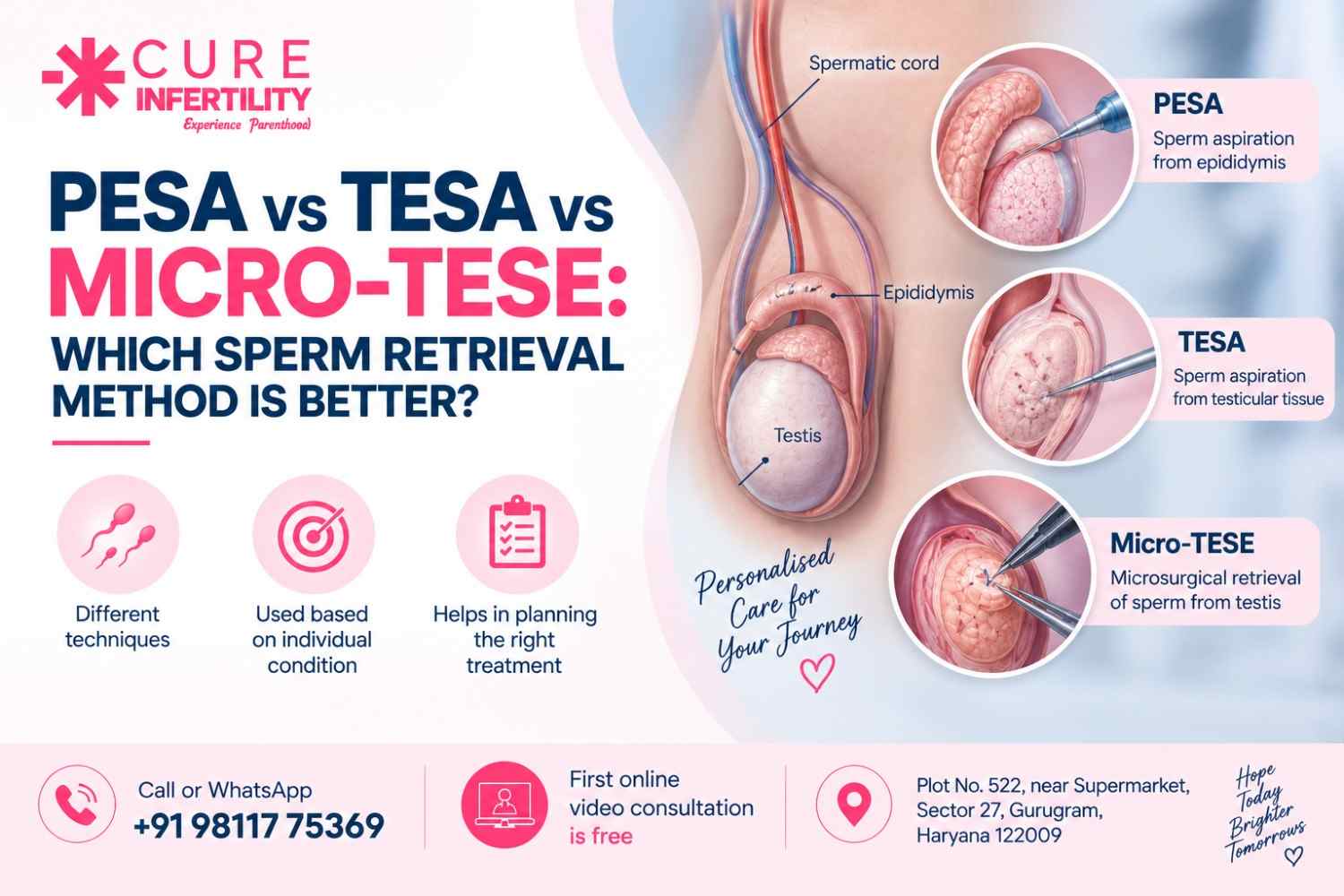
The question "which sperm retrieval method is better" has a frustrating answer: none of them, in isolation. These are not competing options for the same patient. Each is matched to a different cause of azoospermia, and using the wrong one is how men are told no sperm could be found when sperm were there to be found. Here is how they differ and, more importantly, how the right one is chosen.
The Principle Behind All of Them
Every technique here exists to obtain sperm for use with ICSI, where a single sperm is injected directly into each mature egg. Retrieved sperm is scarce, often immature and frequently non-motile, so it cannot be used for conventional fertilisation or IUI. One viable sperm per egg is enough, which is what makes retrieval worthwhile at all.
The choice between techniques rests almost entirely on one question, covered in our article on azoospermia: is this obstructive or non-obstructive?
In obstructive azoospermia, sperm production is normal and the passage is blocked. Sperm are present in abundance behind the blockage, so finding them is straightforward and the simplest technique works.
In non-obstructive azoospermia, production itself is impaired. Sperm may exist only in isolated pockets within the testis, which means the search matters far more than the access.
The Techniques Compared
| PESA | TESA | TESE | Micro TESE | |
|---|---|---|---|---|
| Full name | Percutaneous epididymal sperm aspiration | Testicular sperm aspiration | Testicular sperm extraction | Microdissection TESE |
| Where sperm is taken from | Epididymis | Testis | Testis | Testis |
| Method | Fine needle aspiration | Needle aspiration | Small open biopsy | Open, under operating microscope |
| Incision | None, needle only | None, needle only | Small incision | Incision with microdissection |
| Anaesthesia | Local or sedation | Local or sedation | Local, sedation or general | General |
| Duration | 10 to 20 minutes | 15 to 30 minutes | 30 to 45 minutes | 1 to 3 hours |
| Tissue removed | Minimal | Minimal | Small amount | Least of the open techniques |
| Best suited to | Obstructive | Obstructive | Obstructive, some non-obstructive | Non-obstructive |
| Recovery | 1 to 2 days | 1 to 2 days | Few days | Around a week |
Which Technique for Which Cause
| Cause | Usual first choice |
|---|---|
| Previous vasectomy | PESA |
| Congenital absence of vas deferens | PESA |
| Obstruction from infection or surgery | PESA or TESA |
| Failed epididymal aspiration | TESA or TESE |
| Non-obstructive azoospermia | Micro TESE |
| Klinefelter syndrome | Micro TESE |
| Post-chemotherapy azoospermia | Micro TESE |
| Severe testicular failure with raised FSH | Micro TESE |
The pattern is clear. For obstruction, start simple. For impaired production, go straight to microdissection.
Why Micro TESE Matters So Much in Non-Obstructive Cases
This is the part worth understanding properly, because it is where the real difference between centres lies.
In a testis with impaired production, sperm are not distributed evenly. Production may be confined to a handful of small pockets scattered through the organ. Conventional TESE takes tissue from a few sites essentially blindly, so it can easily miss those pockets entirely. A negative result from a blind biopsy does not reliably mean there is no sperm.
Micro TESE uses an operating microscope at high magnification to examine the seminiferous tubules directly. Tubules containing active sperm production tend to be wider and more opaque than empty ones, and an experienced surgeon can identify and selectively sample them.
Two consequences follow. The yield in non-obstructive azoospermia is meaningfully higher than with conventional TESE. And because only selected tubules are taken, less tissue is removed overall, with less disruption to blood supply and less impact on remaining testosterone production.
The catch is that this depends heavily on surgical experience. Micro TESE performed occasionally is not the same procedure as Micro TESE performed regularly. If you are being offered it, ask how often the centre does them.
Success Rates: The Honest Position
Published figures vary widely between centres and patient groups, so treat any specific number with caution. What holds consistently is the pattern rather than the precise figures.
In obstructive azoospermia, retrieval succeeds in the overwhelming majority of men, regardless of which simple technique is used. PESA is usually attempted first because it is the least invasive, with TESA or TESE as the fallback if it fails.
In non-obstructive azoospermia, retrieval succeeds in a substantial minority of men, and this is where technique choice genuinely changes the outcome. Micro TESE consistently outperforms conventional TESE in this group.
Within non-obstructive cases, prospects also vary by underlying cause. Certain complete Y chromosome microdeletions predict very low likelihood of retrieval, which is one of several reasons genetic testing belongs before the procedure rather than after it.
Ask any centre for their own retrieval rates by technique and by indication. A centre that cannot produce those numbers is telling you something.
Risks and Recovery
All these procedures are generally well tolerated, and the differences between them are proportionate to how invasive they are.
Common to all: scrotal swelling, bruising and discomfort for several days, and small risks of bleeding, haematoma and infection.
Specific to the testicular techniques, particularly the more extensive ones: a small risk of reduced testosterone production afterwards, since testicular tissue is removed. Micro TESE removes less tissue than conventional TESE despite being a longer operation, which works in its favour here. Testosterone levels are worth monitoring after extensive retrieval.
Recovery ranges from a day or two after needle aspiration to around a week after microdissection, with a longer restriction on strenuous activity.
Timing With the Female Partner's Cycle
This decision is as important as the choice of technique, and it is often left to clinic routine rather than discussed.
Same-day retrieval, coordinated with egg collection, uses fresh sperm. The advantage is fresh sperm quality. The risk is that if no sperm is found, the female partner has already completed stimulation and retrieval, and a difficult decision has to be made on the day.
Prior retrieval with freezing obtains and freezes sperm in advance, confirming sperm is available before she begins stimulation. The trade-off is some loss of viability on thawing, though this is manageable with ICSI given the small numbers involved.
In obstructive azoospermia, where success is near-certain, same-day retrieval is reasonable. In non-obstructive azoospermia, retrieving in advance spares the female partner an entire cycle if nothing is found, and is usually the more considerate approach. Raise it explicitly.
What Happens After Retrieval
Retrieved sperm is used with IVF and ICSI. Surplus sperm, where the yield allows, is frozen for future cycles, which avoids repeating the procedure if more attempts are needed. This is worth confirming in advance, since it is a meaningful benefit when yields are good.
From that point, outcomes are driven substantially by the female partner's age and ovarian reserve, as covered in our article on IVF success rates by age. Her workup should run alongside, not after.
The Questions Worth Asking
- Is my azoospermia obstructive or non-obstructive, and what established that?
- Has genetic testing been completed before the procedure is planned?
- Which technique is proposed, and why that one for my cause?
- How many of these procedures does this centre perform, and what are your retrieval rates by indication?
- Will retrieval be done in advance and frozen, or on the day of egg collection?
- Will surplus sperm be frozen for future cycles?
- If no sperm is found, what is the plan?
The Honest Summary
There is no universally better technique. PESA is the least invasive and works well where the problem is obstruction. TESA and TESE extend the options when epididymal aspiration fails. Micro TESE is the technique that matters in non-obstructive azoospermia, where the challenge is finding sperm rather than reaching it.
The far more important variables are whether the cause was correctly established before the procedure, whether genetic testing was done, and how experienced the surgeon is. A simple technique in the right hands for the right indication beats a sophisticated one applied without a diagnosis.
You can read more on the surgical sperm retrieval and ICSI treatment pages, and see the full range of treatment options here.
You can book a free consultation with Dr. Rashmi Agrawal at the Sector 27, Gurugram clinic to review your reports and discuss which approach fits your situation, read more about her background and approach, or check the FAQ page.
FAQs
Which sperm retrieval method is best?
There is no single best method. PESA suits obstructive azoospermia, Micro TESE suits non-obstructive azoospermia, and the right choice depends entirely on the cause. Using the wrong technique is a common reason sperm is not found.
Is PESA painful?
It is done under local anaesthesia or sedation, so it is not painful at the time. Scrotal soreness and swelling for a few days afterwards is normal.
How long does recovery take?
One to two days after PESA or TESA, a few days after conventional TESE, and around a week after Micro TESE, with strenuous activity restricted for longer.
Can these procedures be repeated?
Yes, though repeated testicular procedures carry a cumulative risk to testicular function. This is why freezing surplus sperm at the first retrieval is worth arranging where the yield allows.
Does sperm retrieval affect testosterone levels?
There is a small risk with the testicular techniques, since tissue is removed. Micro TESE removes less tissue than conventional TESE. Testosterone is worth monitoring after extensive retrieval.
Is Micro TESE always better than TESE?
In non-obstructive azoospermia, yes, it has a consistently better yield and removes less tissue. In obstructive azoospermia it is unnecessary, since simpler techniques succeed readily.
Can retrieved sperm be frozen?
Yes, where the yield allows, and it is worth arranging. It avoids repeating the procedure for future cycles.
What if no sperm is found?
A second attempt at a specialist centre is sometimes reasonable, particularly if the first was a conventional TESE rather than a microdissection procedure. Where no sperm can be found, donor sperm and adoption are the remaining routes, and both deserve proper counselling rather than a rushed conversation.