Can You Ovulate With PCOS Even If Your Periods Are Regular?
Regular periods do not always prove ovulation in PCOS. Learn what cycle signs can tell you, why LH strips may mislead, and when a progesterone test helps.
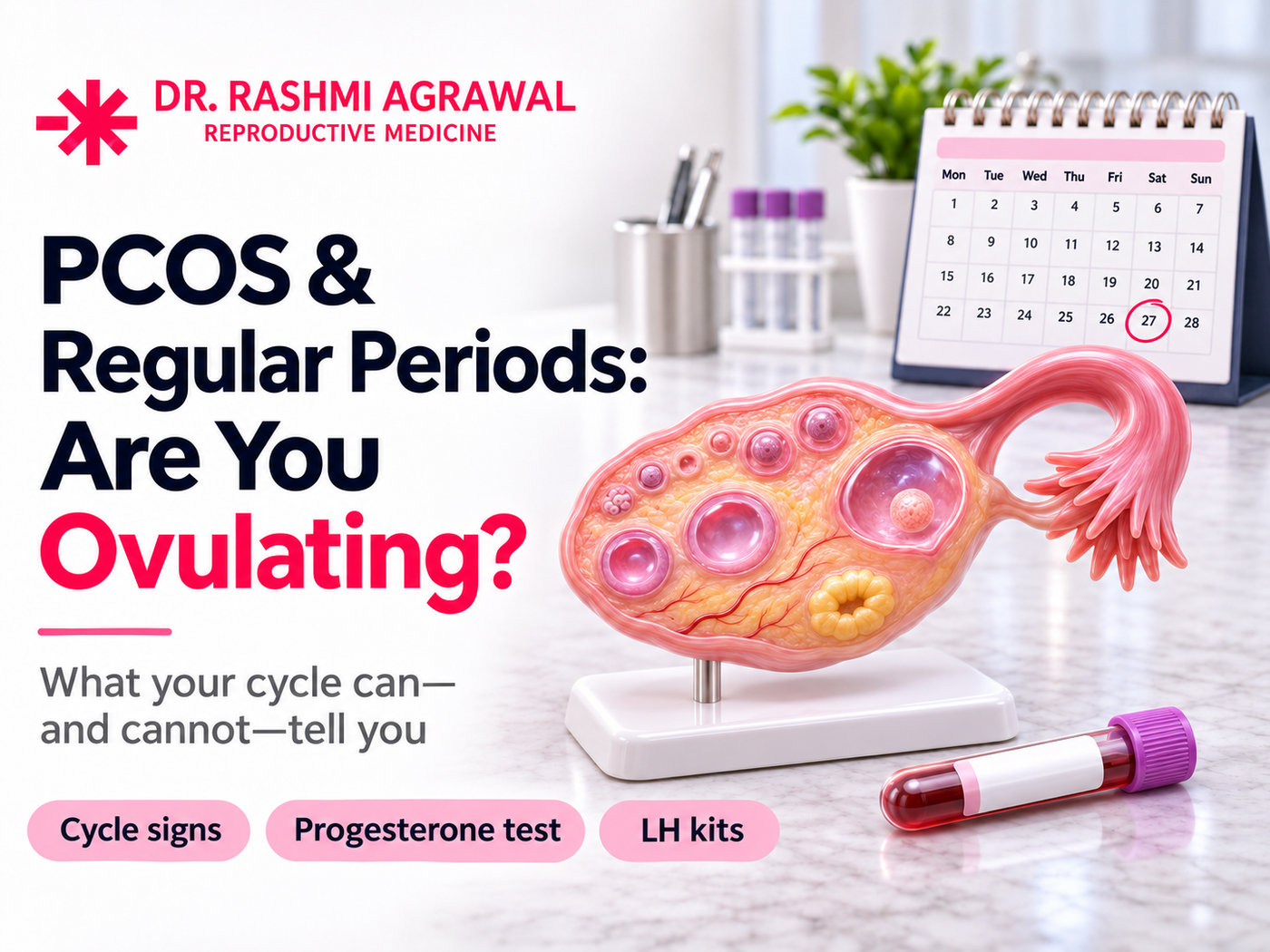
Many people with PCOS have irregular periods, but some have a cycle that arrives on time each month. If your periods look regular, it is reasonable to ask whether you are releasing an egg—and whether you can rely on a calendar or a home ovulation kit to tell.
Short answer: yes, you can ovulate with PCOS, including when your periods are regular. But a regular-looking bleed does not prove ovulation occurred in every cycle. The 2023 international PCOS guideline specifically notes that ovulatory dysfunction can occur with regular cycles. If knowing whether you ovulate would change your care, a clinician can time a progesterone blood test to check.
What does a regular period tell you?
A predictable cycle makes ovulation more likely, but it is a clue rather than a guarantee. Bleeding can sometimes occur without an egg being released. The pattern may also change from month to month. A bleed while taking a combined hormonal pill is a withdrawal bleed and cannot be used to judge whether you are ovulating naturally.
For adults more than three years past their first period, the international PCOS guideline describes cycles shorter than 21 days, longer than 35 days or fewer than eight cycles a year as irregular. If your cycle is outside that range—or your pattern has changed—bring the dates to a clinician. These cut-offs are a reason to assess, not a way to diagnose PCOS by yourself.
Can you have PCOS and still ovulate?
Yes. PCOS does not mean that ovulation never happens. Some people release an egg regularly, some do so only in certain cycles, and others have infrequent ovulation. It is also possible to have PCOS features while your periods seem monthly. That is why treatment should be based on your actual symptoms, cycle history and goals rather than on the label alone.
For the wider picture of symptoms and diagnosis, read our PCOS overview.
How can you check whether you are ovulating?
| Method | What it can tell you | Main limitation |
|---|---|---|
| Cycle calendar | Shows whether bleeding is predictable | Does not prove an egg was released |
| Urine LH kit | May detect the hormone surge before ovulation | PCOS can make positive results misleading |
| Progesterone blood test | Can provide evidence of recent ovulation | Must be timed to your own cycle |
| Ultrasound monitoring | Can track a developing follicle when needed | Requires appointments and clinical interpretation |
A progesterone test is usually more useful than guessing day 21
Progesterone rises after ovulation. The American Society for Reproductive Medicine recommends drawing the blood sample about one week before the period you expect next—not automatically on cycle day 21. For a 35-day cycle, a day-21 test may simply be too early. A result should be interpreted with your cycle dates and the laboratory range. One result can support that ovulation happened, but it cannot tell how 'good' the ovulation was.
Why an LH ovulation kit may confuse you
Home ovulation strips detect luteinising hormone (LH), not the release of an egg itself. Some people with PCOS have higher baseline LH, which can produce a positive strip without the usual ovulation pattern. Repeated positives, a long run of positives or conflicting results are reasons to discuss a different way to check—not proof of infertility.
What about discharge, pain or temperature?
Changes in cervical mucus, one-sided discomfort and basal body temperature can offer clues, but none reliably confirms ovulation on its own. Temperature charts can be especially difficult to interpret and are not routinely recommended when the history already suggests ovulatory cycles. Do not let a phone app's predicted 'fertile day' override a pattern that is irregular for you.
When should you ask for an assessment?
- Your periods are frequently more than 35 days apart, you have fewer than eight periods a year, or you go more than 90 days without a period.
- Your cycles seem regular, but you are trying to conceive and want to confirm ovulation before making a plan.
- Home LH strips give confusing or repeated positive results.
- You have new acne, increased facial or body hair, or other symptoms that need evaluation.
A fertility assessment may also consider sperm and tubal factors when pregnancy has not happened. Ovulation is only one part of conception; a normal progesterone result does not rule out other reasons for a delay.
If pregnancy has not happened despite apparently normal results, our unexplained infertility guide explains the next questions to ask.
Does PCOS mean you will need IVF?
No. Some people with PCOS conceive without fertility treatment. If ovulation is infrequent and pregnancy is the goal, a clinician may discuss lifestyle measures or medicines to induce ovulation, depending on the wider evaluation. The right next step is individual. Having PCOS alone is not a reason to assume IVF is required.
Our ovulation disorders guide explains how irregular ovulation is investigated and managed.
Frequently asked questions
If I bleed every month, am I definitely ovulating?
Not definitely. Monthly bleeding makes ovulation more likely, but the international guideline notes that ovulation problems can occur even with regular cycles. A properly timed progesterone test can help when confirmation matters.
Can an ovulation strip be positive if I have not ovulated?
Yes. LH kits indicate a hormone signal rather than confirming egg release. PCOS can sometimes raise baseline LH and make a positive result misleading.
Is a day-21 progesterone test right for everyone?
No. The timing depends on your usual cycle length. Ask for a test around a week before your expected next period, with your clinician's advice.
Can I get pregnant naturally if I have PCOS?
Yes, many people can. Your chance depends on whether and how often you ovulate, as well as age and other fertility factors. PCOS does not by itself determine your outcome.
Sources
Medically reviewed
Reviewed by Dr. Rashmi Agrawal — MBBS (Gold Medalist), MS OBGYN, FNB Reproductive Medicine, DMC Reg. No. 76953 (2016). This article is general information, not a substitute for a consultation about your own reports.
Book Consultation