Ovulation Disorders: Causes, Diagnosis & Treatment
Ovulation disorders are among the most common causes of female infertility. Learn what causes irregular or absent ovulation, how it's diagnosed, and the treatment options — from lifestyle changes to ovulation induction and IVF.
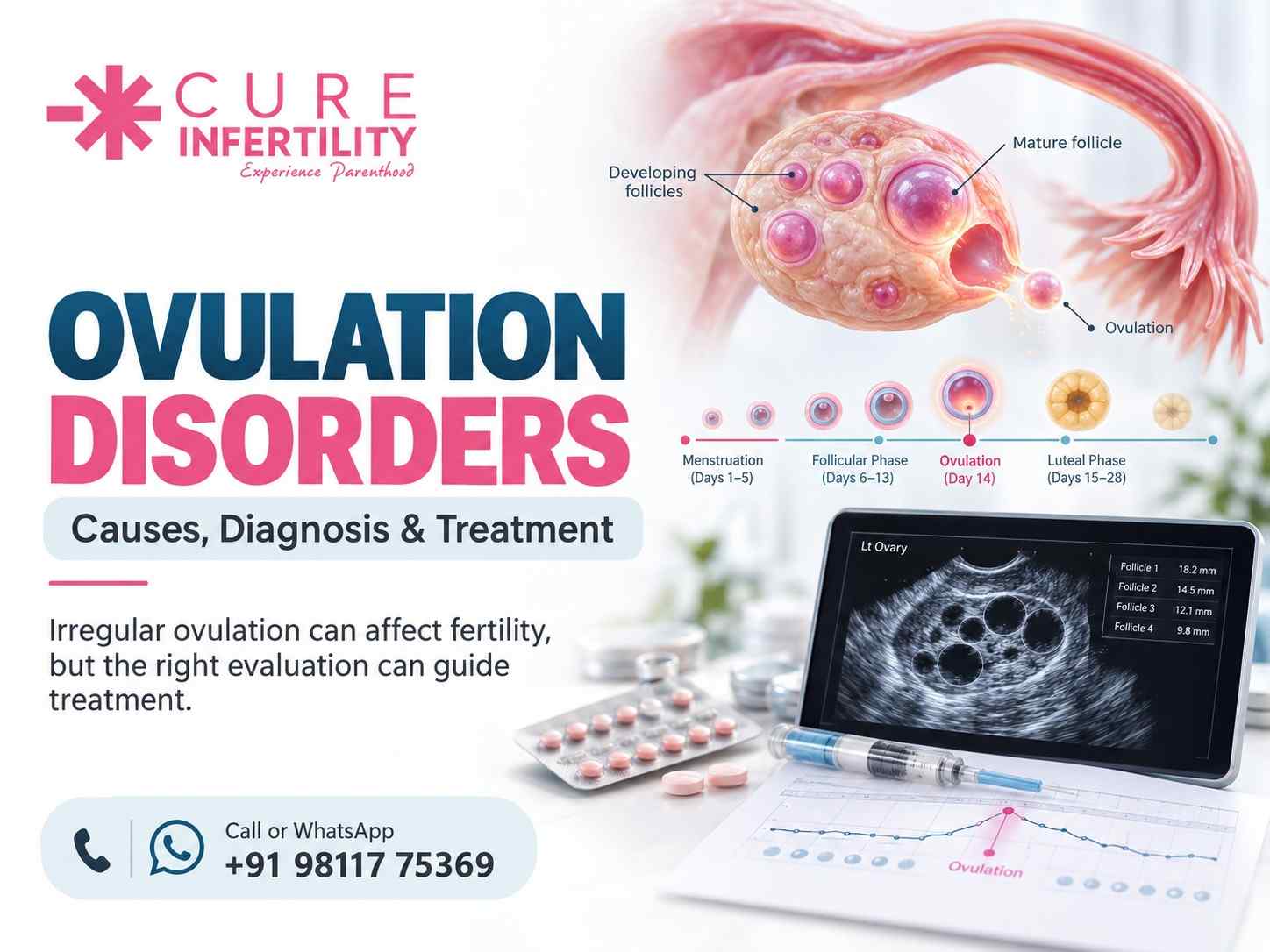
Ovulation disorders are one of the most common causes of female infertility, and also one of the most treatable. Many women whose main problem is irregular or absent ovulation conceive with tablets and monitoring, without ever needing IVF. The key is identifying why ovulation is not happening, because the right treatment depends entirely on the cause. This article explains how ovulation disorders are classified, how they are diagnosed, and how each type is treated.
What Is an Ovulation Disorder?
Ovulation is the release of a mature egg from the ovary, normally once in each menstrual cycle. An ovulation disorder means this is not happening reliably.
There are two broad patterns:
Anovulation, where ovulation does not occur at all in a cycle.
Oligo-ovulation, where ovulation happens, but infrequently or unpredictably.
Either way, the result is fewer opportunities to conceive. A woman who ovulates four times a year has a third of the chances of one who ovulates every month, even if everything else about her fertility is normal.
Signs of an Ovulation Problem
The most reliable sign is the menstrual pattern itself.
- Irregular cycles, typically shorter than 21 days or longer than 35 days, or varying widely from month to month
- Absent periods for three months or more, without pregnancy
- Very infrequent periods, for example fewer than eight a year
Other features can point toward a specific cause: acne, excess facial or body hair and weight gain suggest PCOS; milky nipple discharge suggests high prolactin; hot flushes and night sweats in a younger woman suggest premature ovarian insufficiency; and a history of very low body weight, intense exercise or significant stress suggests a hypothalamic cause.
Regular periods usually indicate regular ovulation, though not always. A woman with regular cycles who has not conceived should still have ovulation confirmed as part of a fertility workup.
The Four Main Types of Ovulation Disorder
In 2022, the International Federation of Gynecology and Obstetrics (FIGO) published a classification that groups ovulatory disorders by where in the hormonal system the problem lies. It is often summarised as HyPO-P: Hypothalamic, Pituitary, Ovarian and PCOS. Thinking about the cause this way is clinically useful, because each group responds to different treatment.
Type 1: Hypothalamic
The hypothalamus, in the brain, sends the signals that start each ovulatory cycle. When it reduces or stops those signals, the ovaries receive no instruction to develop an egg.
The most common cause is functional hypothalamic amenorrhoea, where the body suppresses reproduction in response to an energy deficit or stress. Contributing factors include low body weight, restrictive eating, intense or high-volume exercise, and significant psychological stress, often in combination. Rarer causes include certain genetic conditions and, occasionally, tumours or injury affecting the hypothalamus.
Women with a hypothalamic cause typically have low oestrogen, low FSH and LH, and often absent periods.
Type 2: Pituitary
The pituitary gland relays the hypothalamus's signal to the ovaries. Problems here interrupt that relay.
The most common pituitary cause is high prolactin (hyperprolactinaemia). Prolactin suppresses ovulation. Raised levels can come from a benign pituitary growth called a prolactinoma, from certain medications including some antipsychotics and anti-nausea drugs, or from an underactive thyroid. Milky nipple discharge is a classic but not universal sign.
Less commonly, the pituitary can be damaged, for example after severe bleeding during childbirth.
Type 3: Ovarian
Here the signals are being sent, but the ovaries cannot respond, usually because the supply of eggs is severely depleted.
The main condition is premature ovarian insufficiency (POI): loss of normal ovarian function before the age of 40. Causes include genetic conditions, autoimmune disease, previous chemotherapy or radiotherapy, and ovarian surgery, though often no cause is found. FSH is typically high and AMH very low. Our article on the AMH test explains how ovarian reserve is assessed.
Type 4: PCOS
Polycystic ovary syndrome is by far the most common cause of ovulation disorders. Women with PCOS usually have plenty of developing follicles, but hormonal imbalances, including raised androgens and often insulin resistance, prevent any one of them from maturing and being released.
PCOS has its own complexities, covered in full in our article on PCOS: symptoms, causes and treatment.
Other Contributing Factors
Thyroid disorders, both underactive and overactive, can disrupt ovulation and are easily tested for. Significant obesity can impair ovulation independently of PCOS. And as women approach their forties, cycles naturally become less regular as ovarian reserve declines.
How Ovulation Disorders Are Diagnosed
Cycle history. Cycle length, regularity and any recent changes are the starting point.
Confirming ovulation. The most practical test is a mid-luteal progesterone blood test, taken about seven days before the expected period. A raised level confirms ovulation has occurred in that cycle. Ultrasound follicle tracking, a series of scans across the cycle, shows directly whether a follicle develops and releases. Home ovulation kits and temperature charting are less reliable, particularly in PCOS, where LH levels can be persistently raised and give misleading results.
Blood tests to identify the cause:
- FSH, LH and oestradiol, usually early in the cycle, to distinguish between hypothalamic, ovarian and PCOS patterns
- AMH, reflecting ovarian reserve: high in PCOS, very low in POI
- Prolactin
- Thyroid function (TSH)
- Testosterone and other androgens, where PCOS is suspected
- Glucose and insulin markers, often checked in PCOS
Ultrasound. A transvaginal scan assesses the ovaries and counts the small antral follicles, which helps both diagnosis and treatment planning.
Further imaging such as a pituitary MRI may be arranged if prolactin is significantly raised.
Before Treating Ovulation: Two Essential Checks
Inducing ovulation only helps if the egg can meet sperm. Before starting treatment, two things should always be confirmed:
At least one fallopian tube must be open. This is usually checked with an HSG. Our article on the HSG test covers what it involves.
The male partner's semen analysis must be adequate. Treating ovulation for months while an undiagnosed male factor is present wastes time.
Skipping these checks is one of the most common avoidable errors in fertility treatment.
Treatment by Cause
Hypothalamic Causes
The first step is addressing the underlying energy balance where possible, through regaining weight, reducing exercise intensity, improving nutrition and managing stress. This alone restores ovulation in many women, though it can take months.
Where fertility treatment is needed, ovulation is usually induced with gonadotropin injections containing both FSH and LH, or with pulsatile GnRH, which replaces the missing signal from the hypothalamus. Oral medications such as letrozole and clomiphene generally work poorly in this group, because they rely on a functioning hormonal feedback system that is switched off.
High Prolactin
High prolactin is one of the most satisfying ovulation problems to treat. Medications called dopamine agonists, such as cabergoline, lower prolactin and restore ovulation in the large majority of women, often within a few months. If a medication is causing the raised prolactin, changing it where safe may be enough. Most prolactinomas respond well to medication without surgery.
Thyroid Disorders
Correcting thyroid function often restores regular ovulation on its own.
PCOS
Lifestyle changes come first for women who are overweight. Even a modest weight reduction, in the region of 5 to 10 percent of body weight, can restore ovulation in a meaningful proportion of women with PCOS.
Letrozole is now the first-line medication. A large randomised trial found letrozole produced a higher live birth rate than clomiphene in women with PCOS. It also has less of a thinning effect on the uterine lining.
Clomiphene remains an alternative, but its anti-oestrogen effect can thin the lining over repeated cycles. Our article on endometrial thickness explains why that matters.
Gonadotropin injections are used where oral medications fail. Women with PCOS are sensitive to them, so low doses and close monitoring are essential.
Metformin improves insulin resistance, but on its own it is less effective than letrozole for achieving pregnancy. It has a role in selected women alongside other treatment.
Laparoscopic ovarian drilling, a keyhole procedure on the ovaries, is an option for women who do not respond to oral medication, and can restore ovulation for a period without the multiple pregnancy risk of injections.
Premature Ovarian Insufficiency
POI is the hardest group to treat with the woman's own eggs. Occasional spontaneous ovulation does happen, and some women conceive naturally, but ovulation induction is rarely effective. For most women with established POI who want a pregnancy, donor eggs with IVF offer the realistic route. Hormone replacement is also important for long-term bone and heart health.
How Ovulation Induction Works in Practice
Most ovulation induction uses a few days of tablets early in the cycle, followed by ultrasound scans to track follicle growth. Monitoring matters for two reasons: to confirm the treatment is working, and to avoid too many follicles developing at once, which raises the risk of twins or more. A trigger injection is sometimes used to time ovulation precisely, followed by timed intercourse or IUI. Our page on ovulation induction and cycle monitoring covers the process.
Unmonitored use of fertility tablets, without scans, is not recommended.
When to Move Beyond Ovulation Induction
Once ovulation is restored, the chance of conception each month approaches that of a woman who ovulates naturally. Many women conceive within a few ovulatory cycles.
If pregnancy has not happened after several cycles in which ovulation was confirmed, it is time to reassess rather than keep repeating. That might mean adding IUI, or moving to IVF, particularly where age or other factors make time a constraint. Our article on IUI vs IVF explains how that decision is made.
IVF is also the appropriate route straight away where both tubes are blocked, where there is significant male factor, or where POI means donor eggs are needed.
Long-Term Health Matters Too
Ovulation disorders are not only a fertility issue.
Women who rarely have periods, particularly with PCOS, can develop a thickened uterine lining over time, which needs protecting with regular progesterone or hormonal treatment. Women with hypothalamic amenorrhoea or POI have low oestrogen, which affects bone density and needs attention whether or not pregnancy is planned.
Questions Worth Asking
- Has ovulation been confirmed or ruled out with a progesterone test or scans?
- Which type of ovulation disorder do I have, and what tests confirmed it?
- Have my tubes and my partner's semen analysis been checked?
- Why this medication rather than another?
- How many monitored cycles will we try before reviewing?
You can see the full range of treatment options here.
You can book a free consultation with Dr. Rashmi Agrawal at the Sector 27, Gurugram clinic to investigate irregular cycles and plan treatment, read more about her background and approach, or check the FAQ page.
FAQs
What are the most common causes of ovulation disorders?
PCOS is by far the most common. Others include hypothalamic causes related to low weight, exercise or stress, high prolactin, thyroid disorders and premature ovarian insufficiency.
Can you have periods without ovulating?
Yes, occasionally. Bleeding can occur without ovulation, which is why ovulation should be confirmed with a progesterone test or scans rather than assumed from periods alone.
How is ovulation confirmed?
Most commonly with a mid-luteal progesterone blood test, taken about seven days before the expected period, or with ultrasound scans tracking a follicle through to release.
Is letrozole better than clomiphene?
For women with PCOS, a large randomised trial found letrozole led to more live births than clomiphene. It is now the usual first-line medication in this group.
Can ovulation disorders be cured?
Many can be corrected. High prolactin and thyroid disorders often respond fully to treatment, and hypothalamic causes can resolve when energy balance is restored. PCOS is managed rather than cured, and POI is usually permanent.
Do I need IVF if I don't ovulate?
Usually not. Most women with ovulation disorders conceive with ovulation induction. IVF is needed when other factors are present, when induction has not worked after several ovulatory cycles, or with premature ovarian insufficiency.
Can stress stop ovulation?
Yes. Significant stress, especially combined with low energy intake or intense exercise, can suppress the hypothalamic signals that drive ovulation.
Are ovulation induction tablets safe without scans?
They are not recommended without monitoring. Scans confirm the treatment is working and reduce the risk of multiple pregnancy.
References
- Munro MG, Balen AH, et al. The FIGO ovulatory disorders classification system. International Journal of Gynecology & Obstetrics, 2022. https://obgyn.onlinelibrary.wiley.com/doi/10.1002/ijgo.14331
- Legro RS, et al. Letrozole versus clomiphene for infertility in the polycystic ovary syndrome. New England Journal of Medicine. https://www.nejm.org/doi/full/10.1056/NEJMoa1313517
- A comprehensive review of the new FIGO classification of ovulatory disorders. Human Reproduction Update. https://academic.oup.com/humupd/article/30/3/355/7615073
Medically reviewed
Reviewed by Dr. Rashmi Agrawal — MBBS (Gold Medalist), MS OBGYN, FNB Reproductive Medicine. This article is general information, not a substitute for a consultation about your own reports.
Book Consultation