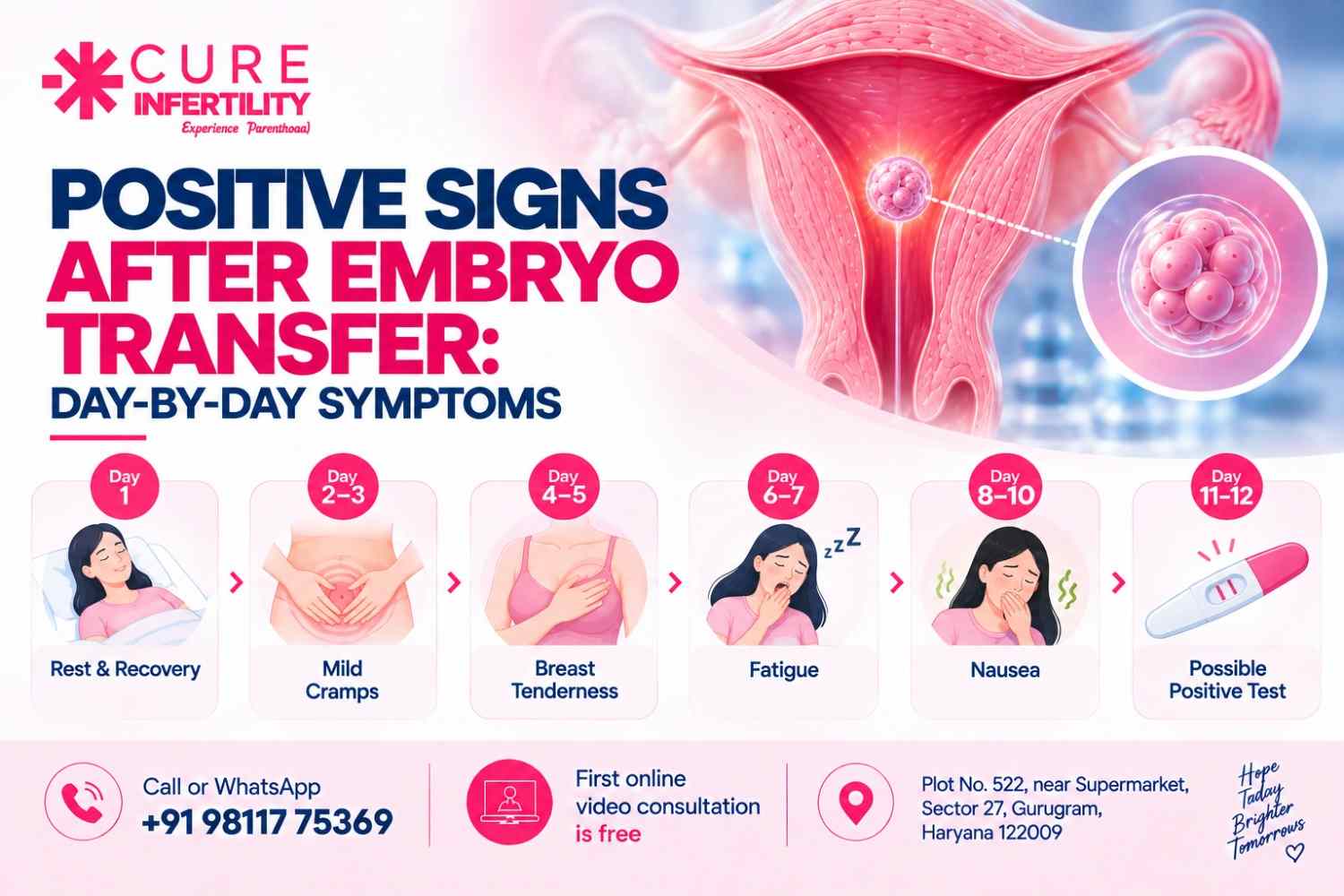
Positive Signs After Embryo Transfer: Day-by-Day Symptoms
Learn about possible symptoms after embryo transfer, what you may notice day by day, and which signs can occur during implantation or early pregnancy.
The two weeks after an embryo transfer are, for many couples, the hardest part of the entire IVF journey. Every twinge feels like a message. Every absence of a twinge feels like a verdict. So it is worth starting with the most useful thing anyone can tell you about this period, and the thing most articles on this topic avoid saying: there is no symptom that reliably tells you whether the transfer has worked.
That is not bad news. It means a lack of symptoms is not a bad sign either. This article walks through what is actually happening inside your body day by day, what you might feel, what those feelings really mean, and when to call your clinic.
Why Symptoms Cannot Tell You the Answer
After an embryo transfer, almost every woman is taking progesterone, and some have recently had an hCG trigger injection. Progesterone produces breast tenderness, bloating, tiredness, mild cramping, mood changes and constipation. Those are also the symptoms of early pregnancy.
So a woman who is pregnant and a woman who is not can feel exactly the same during these two weeks, because the same hormone is producing the same effects in both. Many women with successful transfers feel nothing at all. Many women with negative results feel every symptom on the list.
The only reliable answer is the blood test your clinic schedules. Everything before that is guesswork.
What Is Happening Day by Day
The timeline below assumes a day 5 blastocyst transfer, which is now the most common, particularly in a frozen embryo transfer. If you had a day 3 transfer, add roughly two days to each stage.
Embryos vary, so these are approximate, and a slightly later or earlier timeline is entirely normal.
Day 0: Transfer Day
The blastocyst is placed into the uterus. It does not attach immediately. It floats within the uterine cavity, continuing to develop and expand.
What you might feel: mild cramping from the catheter and speculum, a full bladder from the ultrasound, some light spotting from the cervix. All normal, and all related to the procedure rather than the embryo.
Day 1 to 2: Hatching
The blastocyst begins hatching out of its outer shell, the zona pellucida. Once free, it can make contact with the lining of the uterus.
What you might feel: mild cramping, bloating, tiredness. These come from progesterone and, after a fresh transfer, from the ovaries still settling after stimulation.
Day 2 to 4: Attachment and Implantation
The hatched blastocyst attaches to the uterine lining and begins embedding into it. The outer cells of the embryo, which will form the placenta, start invading the lining and connecting with its blood supply.
What you might feel: some women notice light cramping or a little spotting around this point and interpret it as implantation. It might be. It might equally be progesterone pessaries irritating the cervix, or nothing at all. There is no way to tell the difference from the outside.
Day 4 to 6: Implantation Completes and hCG Begins
Implantation is largely complete. The developing placental cells begin producing hCG, the pregnancy hormone, which signals the body to maintain the pregnancy.
What you might feel: probably nothing new. hCG levels are still very low at this stage, far too low to produce symptoms such as nausea.
Day 6 to 8: hCG Rises
If implantation has occurred, hCG roughly doubles every couple of days in early pregnancy. It is rising, but may not yet be high enough for a reliable test.
What you might feel: breast tenderness, tiredness and bloating, which are typically still due to progesterone. Some women begin to notice mild changes, many do not.
Day 9 to 11: Blood Test Window
hCG is usually high enough to be detected reliably on a blood test. This is why most clinics schedule the beta hCG test around this point after a blastocyst transfer.
What you might feel: for some women, the first true pregnancy symptoms begin to appear in the following week or two. For most, nothing distinguishes this day from the ones before it.
Common Symptoms and What They Actually Mean
Cramping. Very common in both outcomes. Caused by progesterone, the procedure itself, and the uterus responding to medication. Mild cramping is not a sign of failure, and it is not a reliable sign of success.
Spotting. Light spotting is common and does not mean the cycle has failed. It may come from the cervix after the transfer or from vaginal progesterone. It is sometimes from implantation. Heavy bleeding like a period is different, and worth reporting.
Breast tenderness. Almost always caused by progesterone at this stage. It is one of the least useful signs, because nearly everyone taking luteal support has it.
Bloating and fatigue. Progesterone, plus after a fresh transfer, recovery from ovarian stimulation. Our article on what happens after egg retrieval explains why bloating can peak after retrieval rather than immediately.
Nausea. Unlikely to be pregnancy-related this early, since hCG levels are still very low. Pregnancy nausea usually starts a few weeks later.
Frequent urination. Possible, but not reliable this early.
Mood swings and anxiety. Progesterone affects mood, and the waiting itself is stressful. Both are entirely normal.
No symptoms at all. Extremely common, including in women who turn out to be pregnant. It is not a negative sign.
Why Testing at Home Early Is a Bad Idea
The temptation is understandable. The problem is that early home tests frequently mislead in both directions.
False positives. If you had an hCG trigger injection, traces of it can remain in your system for over a week after the injection, producing a positive home test that has nothing to do with pregnancy.
False negatives. Testing before hCG has risen enough can produce a negative result in a woman who is in fact pregnant, causing unnecessary distress, and sometimes leading women to stop medication they should be continuing.
Wait for the scheduled blood test. It gives a number, not a yes or no, and that number tells your doctor considerably more.
What You Must Not Do: Stop Your Medication
This is the single most important practical point in the two-week wait.
Do not stop or reduce progesterone, oestrogen or any prescribed medication based on symptoms, spotting, or a home test. In a medicated frozen transfer cycle, your body is not producing its own progesterone, and stopping it early can end a pregnancy that was otherwise developing normally.
Continue every medication exactly as prescribed until your clinic tells you otherwise.
Common Myths in the Two-Week Wait
"You must stay in bed after the transfer." Bed rest has not been shown to improve implantation. Normal daily activity is fine, and gentle walking is encouraged.
"Climbing stairs or lifting light things will dislodge the embryo." The embryo is inside the uterine cavity, not sitting near the opening. Ordinary movement does not dislodge it.
"Avoid papaya and pineapple." Normal dietary amounts are not harmful. The concerns come from concentrated extracts, not everyday food.
"Sneezing or coughing can push the embryo out." It cannot.
"Feeling nothing means it has not worked." Many successful pregnancies are symptom-free at this stage.
"Spotting means it has failed." Light spotting is common in successful cycles.
When to Call Your Clinic
Most of what you feel in the two-week wait is normal. Call your clinic promptly if you experience:
- Heavy bleeding similar to or heavier than a period
- Severe or worsening abdominal pain
- Rapid weight gain over a few days, marked abdominal swelling, breathlessness or reduced urine output, particularly after a fresh transfer, since these can indicate ovarian hyperstimulation
- Fever
- Fainting or dizziness
After the Blood Test
If the test is positive, your clinic will usually repeat it after 48 to 72 hours to confirm hCG is rising appropriately, followed by an ultrasound a few weeks later to confirm the pregnancy is in the uterus and to look for a heartbeat. A single number matters less than how it changes.
If the test is negative, stop medication only when your clinic advises. A single failed transfer is common, even with good-quality embryos, and is not on its own diagnostic. Chromosomal abnormality in the embryo is the most common reason, which is something PGT-A can address in selected couples. After two or more failed transfers of good embryos, it is worth investigating rather than repeating. Our articles on what causes failed IVF and tests to consider after repeated failure cover that workup.
Getting Through the Two Weeks
There is nothing you can do in these two weeks to make the embryo implant, and nothing ordinary you can do to stop it. That is hard to accept, but it also removes a burden that many women carry unnecessarily: the sense that every action could be the wrong one.
Practical things that help: keeping to your normal routine, planning a few distractions for the second week, limiting time on symptom forums where every experience is different, and agreeing with your partner in advance how you will handle the result day.
You can read more on the IVF treatment page and see the full range of treatment options here.
You can book a free consultation with Dr. Rashmi Agrawal at the Sector 27, Gurugram clinic, read more about her background and approach, or check the FAQ page.
FAQs
What are the positive signs after embryo transfer?
There is no symptom that reliably confirms pregnancy before the blood test. Cramping, breast tenderness, bloating and tiredness are common, but progesterone causes the same symptoms whether or not you are pregnant.
Is it normal to have no symptoms after embryo transfer?
Yes, very. Many women with successful transfers feel nothing unusual during the two-week wait. A lack of symptoms is not a negative sign.
When does implantation happen after a blastocyst transfer?
Usually within a few days. A day 5 blastocyst typically hatches, attaches and begins implanting within roughly one to five days after the transfer.
Is cramping after embryo transfer a good sign?
Mild cramping is common in both successful and unsuccessful cycles. It is usually caused by progesterone or the procedure, and is not a reliable indicator either way.
Is spotting after embryo transfer normal?
Light spotting is common and does not mean the cycle has failed. Heavy bleeding similar to a period should be reported to your clinic.
When can I take a pregnancy test after embryo transfer?
Your clinic will usually schedule a blood test around 9 to 11 days after a blastocyst transfer. Home tests taken earlier can give false positives from a trigger injection or false negatives from testing too soon.
Should I rest completely after embryo transfer?
No. Bed rest has not been shown to help. Normal daily activity is fine.
Can I stop progesterone if I start bleeding?
No. Never stop or reduce prescribed medication without your clinic's instruction, even if you are bleeding or a home test is negative.
References
- Wilcox AJ, Baird DD, Weinberg CR. Time of implantation of the conceptus and loss of pregnancy. New England Journal of Medicine. https://www.nejm.org/doi/full/10.1056/nejm199906103402304
- The association of maternal factors with delayed implantation and the initial rise of urinary human chorionic gonadotrophin. https://pmc.ncbi.nlm.nih.gov/articles/PMC3057753/
Medically reviewed
Reviewed by Dr. Rashmi Agrawal — MBBS (Gold Medalist), MS OBGYN, FNB Reproductive Medicine. This article is general information, not a substitute for a consultation about your own reports.
Book Free Consultation