Does Smoking Cigarettes Reduce Sperm Count and Affect Fertility?
Smoking lowers sperm count, motility and DNA quality, and harms the female partner's fertility too, including through secondhand smoke. Most of the damage is reversible after quitting. See what the evidence shows and how long recovery takes.
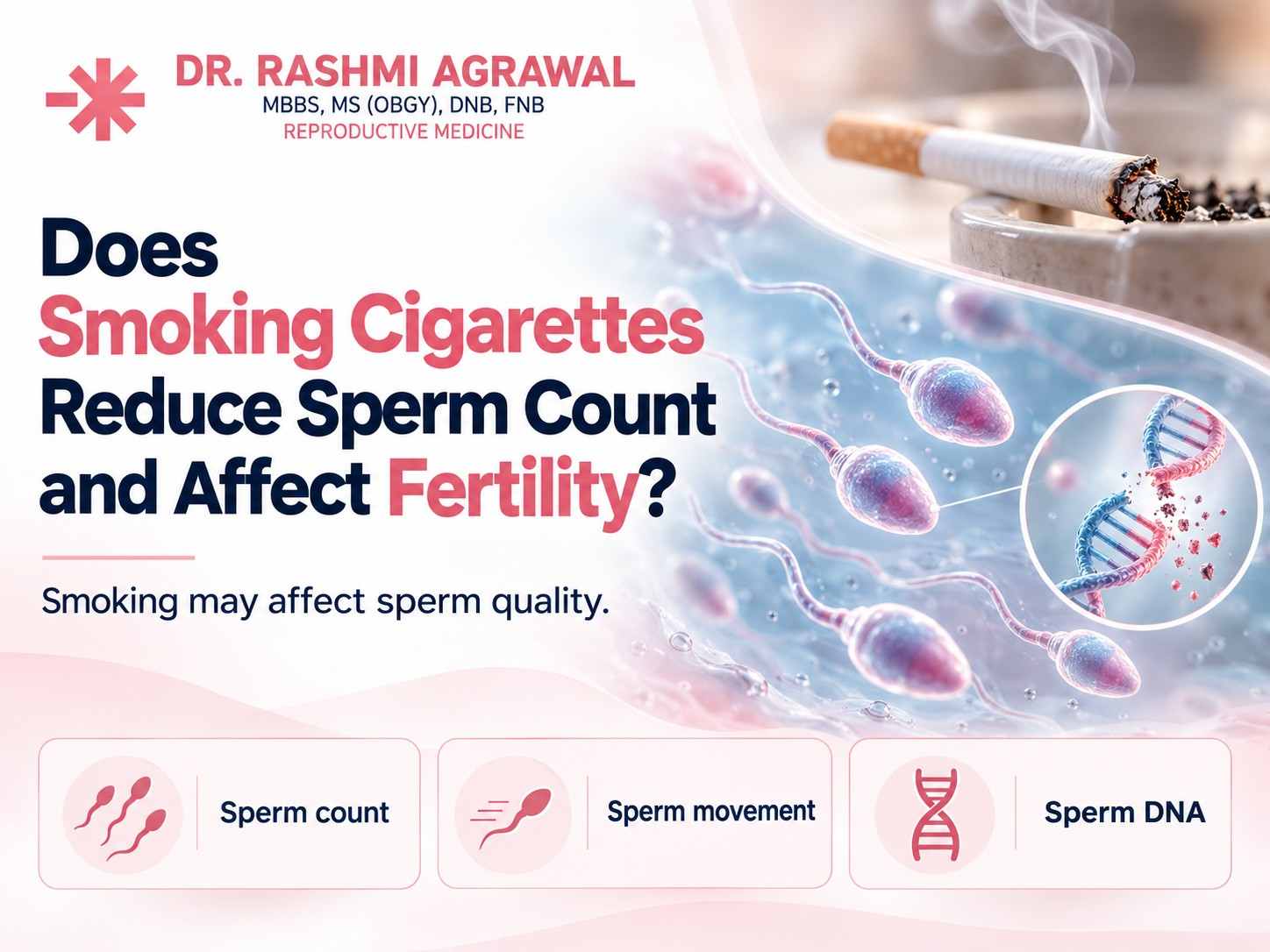
Yes. Smoking lowers sperm count, reduces how well sperm swim, increases the proportion of abnormally shaped sperm, and damages the DNA sperm carry. It also harms the female partner's fertility, including through secondhand smoke. The encouraging part is that most of the damage to sperm is reversible, and quitting is one of the few fertility interventions that is entirely in your control. This article explains what smoking does, what the evidence shows, and how long it takes to recover after stopping.
What Smoking Does to Sperm
Cigarette smoke contains thousands of chemicals, including nicotine, carbon monoxide, cadmium, lead and other toxins. Several of these reach the reproductive tract and are measurable in semen. They affect sperm in several ways.
Oxidative stress. Smoking increases reactive oxygen species, unstable molecules that damage cell membranes and DNA. Sperm are particularly vulnerable, because they have limited ability to repair themselves.
Direct toxic effects. Heavy metals such as cadmium and lead accumulate in the testes and interfere with sperm production.
DNA damage. Smoking is associated with higher sperm DNA fragmentation, chromosomal abnormalities in sperm, and changes in how genes are switched on and off.
Hormonal effects. Smoking can alter the hormones that regulate sperm production.
Reduced blood flow. Smoking damages blood vessels, which matters for both sperm production and erectile function.
What the Research Shows
The effect of smoking on semen quality has been studied extensively, and the findings are consistent.
A large meta-analysis published in European Urology, pooling results from many thousands of men, found that smoking was associated with reduced sperm count, motility and morphology. The effect was more pronounced in men who smoked moderately or heavily, and in men already being investigated for infertility.
The American Society for Reproductive Medicine reached a similar conclusion in its 2024 committee opinion: smoking is linked to lower sperm concentration, motility and morphology, along with sperm DNA damage and chromosomal abnormalities that may contribute to pregnancy loss.
Two nuances are worth knowing.
Many smokers still have semen values within the normal range. Smoking shifts the numbers downward, but it does not necessarily push them below the reference limits. A "normal" semen analysis does not mean smoking is having no effect.
The damage you cannot see may matter most. A routine semen analysis measures count, motility and shape. It does not measure DNA integrity. Sperm with damaged DNA can still fertilise an egg, but the resulting embryo is more likely to stop developing, fail to implant or miscarry. Our article on the sperm DNA fragmentation test explains when testing for this is worthwhile.
Is There a Safe Number of Cigarettes?
The effects are dose-dependent: the more you smoke, the greater the harm. That does not mean light smoking is harmless. There is no level of smoking that has been shown to be safe for fertility, and the most reliable benefit comes from stopping completely rather than cutting down.
Smoking and Erectile Function
Smoking damages the lining of blood vessels and is a well-established risk factor for erectile dysfunction, independent of age. For a couple trying to conceive, difficulties with erection or ejaculation can reduce opportunities to conceive as much as any change in sperm quality. This is often the more noticeable effect for men, and one of the more persuasive reasons to quit.
Smoking Affects Her Fertility Too
Smoking is a couple's issue, not only a male one. The ASRM's 2024 review set out the effects on women clearly:
- Earlier menopause. Smoking appears to accelerate the loss of eggs from the ovaries, bringing menopause forward by around one to four years.
- Lower ovarian reserve. Smokers tend to have lower AMH levels, and those levels decline faster. Our article on the AMH test explains what that means.
- Longer time to conceive, with the effect increasing the more she smokes.
- Higher rates of miscarriage and ectopic pregnancy.
- Poorer IVF outcomes. Smokers appear to need nearly twice as many IVF cycles to conceive, typically need higher doses of stimulation medication, produce fewer eggs, and have lower implantation rates. The effects are more pronounced in older women.
Our article on IVF success rates by age explains why ovarian reserve matters so much. Smoking effectively ages the ovaries faster.
Secondhand Smoke Matters
A partner who does not smoke is not protected by that alone. According to the ASRM review, heavy exposure to secondhand smoke may cause reproductive harm comparable to active smoking, and passive exposure is associated with reduced fertility only slightly smaller than that of smoking yourself.
In many Indian households, a woman who has never smoked is exposed daily through a partner or family member. If one partner smokes indoors or in the car, both partners' fertility may be affected.
What About Bidis, Hookah, Chewing Tobacco and Vaping?
Bidis and hookah deliver tobacco smoke and the same toxins, often in higher amounts than cigarettes. A hookah session can involve a large volume of smoke. There is no reason to consider either safer.
Chewing tobacco, gutka and other smokeless products still deliver nicotine and toxins into the bloodstream. Evidence specifically on male fertility is more limited, but smokeless tobacco has been linked to pregnancy loss, and it should not be assumed to be harmless.
E-cigarettes and vaping. Human data are limited, but they do not support vaping as a safe alternative. One study found lower sperm counts among men who used e-cigarettes, and animal studies suggest harm to sperm and to early pregnancy. E-cigarettes are also banned in India, though they remain in use.
The simplest summary is that switching from one form of tobacco or nicotine to another is not a fertility strategy. Stopping is.
How Long Does It Take to Recover After Quitting?
Sperm take roughly 74 days to develop, plus time to travel through the reproductive tract. That means the sperm you produce today began developing around three months ago.
The practical consequence: improvements in sperm quality generally start to show around three months after stopping. A repeat semen analysis is most informative after that point. Some improvement continues beyond three months as the body clears accumulated toxins and recovers from oxidative damage.
For women, the ASRM review notes that much of the reduction in fertility may reverse within a year of quitting, though the loss of eggs that has already occurred cannot be recovered.
If you are planning fertility treatment, quitting at least three months before starting gives the treatment the best chance. If treatment is already underway, quitting now still helps every future cycle.
Getting Help to Quit
Willpower alone works for some people, but support improves success considerably. The ASRM identifies nicotine replacement therapy, varenicline and bupropion as first-line options for stopping smoking before conception. Whether these are suitable for you is a decision to make with a doctor, particularly if pregnancy is planned soon, since the right choice depends on timing and on which partner is quitting.
Counselling, quit-smoking services and support from your partner all help. Quitting together, if both of you smoke, is considerably easier than one person trying alone in a smoking household.
When to Get Tested
If you smoke and have been trying to conceive for a year without success, or six months if your partner is 35 or older, both of you should be assessed. For the man, that starts with a semen analysis. Where there have been failed IVF cycles or recurrent miscarriages, sperm DNA fragmentation testing may be worthwhile.
If the count is reduced, our article on low sperm count explains the options, including when ICSI is used. Quitting smoking is still worthwhile even when treatment such as ICSI is planned, because ICSI achieves fertilisation but does not repair damaged sperm DNA.
Common Myths
"My semen analysis is normal, so smoking isn't affecting me." Routine analysis does not measure DNA damage, which smoking increases.
"Just a few a day won't matter." The effect is dose-dependent, but no level of smoking has been shown to be safe for fertility.
"Vaping is the safe option." The evidence does not support it as a safe alternative.
"Smoking only affects the man's sperm." It affects the female partner's eggs, ovarian reserve and pregnancy outcomes, including through secondhand smoke.
"The damage is permanent, so there's no point quitting." Sperm quality generally improves within months of stopping.
You can see the full range of treatment options here.
You can book a free consultation with Dr. Rashmi Agrawal at the Sector 27, Gurugram clinic for a fertility assessment for both partners, read more about her background and approach, or check the FAQ page.
FAQs
Does smoking reduce sperm count?
Yes. Research consistently links smoking to lower sperm count, reduced motility and more abnormally shaped sperm, with greater effects in heavier smokers.
Can smoking cause infertility in men?
Smoking reduces semen quality and damages sperm DNA, which can lower the chance of conception and increase the risk of miscarriage. Many smokers remain fertile, but their odds are reduced.
How long after quitting smoking does sperm improve?
Sperm take around three months to develop, so improvements in semen quality usually begin to show about three months after stopping.
Does secondhand smoke affect fertility?
Yes. Heavy exposure to secondhand smoke may cause reproductive harm comparable to active smoking, which is why both partners should avoid it.
Is vaping safer than smoking for fertility?
The evidence does not support that. Data are limited, but studies suggest vaping can also affect sperm and early pregnancy.
Does chewing tobacco affect fertility?
It still delivers nicotine and toxins, and smokeless tobacco has been linked to pregnancy loss. It should not be assumed to be harmless for fertility.
Does smoking affect IVF success?
Yes. Smokers appear to need nearly twice as many IVF cycles to conceive, produce fewer eggs and have lower implantation rates.
Should I quit smoking before IVF?
Yes, ideally at least three months before starting, so that sperm produced for the cycle have developed without exposure. Quitting at any point still helps future cycles.
References
1. Practice Committee of the American Society for Reproductive Medicine. Tobacco or marijuana use and infertility: a committee opinion (2024). https://www.asrm.org/practice-guidance/practice-committee-documents/tobacco-or-marijuana-use/
2. Sharma R, Harlev A, Agarwal A, Esteves SC. Cigarette smoking and semen quality: a new meta-analysis examining the effect of the 2010 World Health Organization laboratory methods for the examination of human semen. European Urology, 2016. https://www.europeanurology.com/article/S0302-2838(16)30069-0/abstract
Medically reviewed
Reviewed by Dr. Rashmi Agrawal — MBBS (Gold Medalist), MS OBGYN, FNB Reproductive Medicine, DMC Reg. No. 76953 (2016). This article is general information, not a substitute for a consultation about your own reports.
Book Consultation