IVF vs ICSI: What Is the Difference?
Understand the difference between IVF and ICSI, how each treatment works, when ICSI may be recommended, and which factors can influence the choice of treatment.
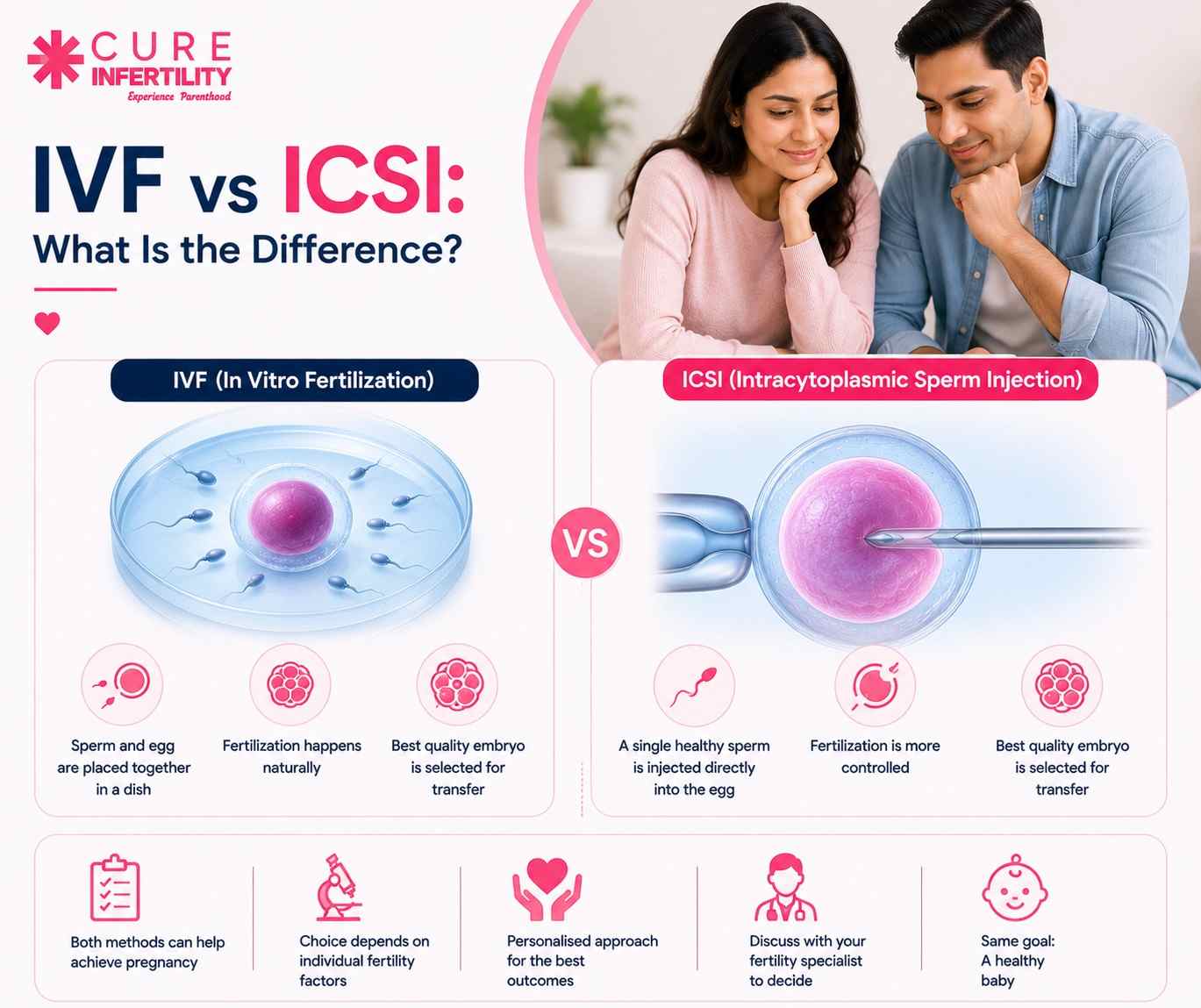
The most common misunderstanding about IVF and ICSI is that they are two competing treatments you choose between. They are not. ICSI is a fertilisation technique used inside an IVF cycle. Everything before and after that single step is identical. Here is exactly where they differ, when ICSI is genuinely needed, and when it is being used because it is easier to sell than to justify.
The Only Step That Differs
An IVF cycle has the same sequence regardless: ovarian stimulation, monitoring, trigger, egg retrieval, fertilisation in the lab, embryo culture, and transfer. The injections, the scans, the retrieval and the transfer are the same either way.
The difference sits entirely in the fertilisation step, and it lasts a matter of hours.
Conventional IVF. Retrieved eggs are placed in a dish with a prepared sperm sample, typically tens of thousands of motile sperm per egg. Fertilisation happens on its own. The sperm has to reach the egg, bind to its outer layer, penetrate it and fuse, all under its own capability. The lab creates the conditions and then lets biology do the work.
ICSI (intracytoplasmic sperm injection). An embryologist selects a single sperm, immobilises it, and injects it directly into the cytoplasm of the egg using a fine glass needle under high magnification. Each mature egg is injected individually. The sperm does not need to swim, bind or penetrate anything.
That is the whole distinction. One relies on sperm capability, the other bypasses it.
| Conventional IVF | ICSI | |
|---|---|---|
| Stimulation and monitoring | Same | Same |
| Egg retrieval | Same | Same |
| Fertilisation method | Eggs and prepared sperm placed together in a dish | One sperm injected directly into each mature egg |
| Sperm required | Tens of thousands of motile sperm per egg | One viable sperm per egg |
| Sperm must swim, bind and penetrate | Yes | No |
| Natural sperm selection | Retained | Bypassed, embryologist selects visually |
| Embryo culture and transfer | Same | Same |
| Additional lab cost | No | Yes |
When ICSI Is Genuinely Indicated
ICSI exists to solve a fertilisation problem. Where a fertilisation problem exists, it is transformative. The clear indications:
Significant male factor infertility. Low sperm count, poor motility, or abnormal morphology to a degree where conventional fertilisation is unlikely to succeed.
Surgically retrieved sperm. Where sperm is obtained directly from the testis or epididymis through surgical sperm retrieval techniques such as PESA, TESA or Micro TESE, the numbers are small and the sperm is often immature and non-motile. ICSI is mandatory here, not optional.
Previous fertilisation failure. If a prior conventional IVF cycle produced few or no fertilised eggs despite adequate sperm, ICSI is the logical response.
Frozen eggs. Vitrification slightly hardens the outer layer of the egg, making conventional fertilisation less reliable. ICSI is standard practice when using previously frozen eggs, which is why it applies to anyone using eggs banked through the process described in our guide to egg freezing.
When genetic testing is planned. PGT requires ICSI, because conventional insemination leaves stray sperm attached to the outside of the egg, which can contaminate the genetic sample taken from the embryo.
Very few eggs retrieved. Where only two or three eggs are available, some centres use ICSI to reduce the risk of total fertilisation failure, though this rationale is more debated than the ones above.
Summarised:
| Situation | Is ICSI needed? |
|---|---|
| Significant male factor (low count, motility or morphology) | Yes, clearly indicated |
| Surgically retrieved sperm (PESA, TESA, Micro TESE) | Yes, mandatory |
| Previous total or near-total fertilisation failure | Yes, indicated |
| Using previously frozen eggs | Yes, standard practice |
| Genetic testing of embryos (PGT) planned | Yes, required |
| Very few eggs retrieved | Sometimes, debated |
| Normal semen analysis, no other indication | No proven live birth benefit |
| Unexplained infertility with normal sperm | No proven live birth benefit |
The Part Most Articles Leave Out
ICSI is used far more widely than the indications justify. In many parts of the world it is applied to the majority of cycles, including a large number with entirely normal sperm parameters.
The evidence on this is reasonably clear: in couples without male factor infertility, ICSI does not improve live birth rates compared to conventional IVF. It reliably improves the fertilisation rate per egg, which sounds like the same thing but is not. Fertilisation is an intermediate step. What matters is whether you take home a baby, and on that outcome, ICSI adds nothing when the sperm was capable of fertilising the egg on its own.
Why is it used anyway? Partly to avoid the small but real risk of unexpected total fertilisation failure, which is distressing for everyone involved. Partly because it produces cleaner-looking laboratory statistics. And partly because it is an additional billable procedure.
If ICSI is being recommended to you, the question to ask is direct: what specific finding in our results makes ICSI necessary in our case? A clear answer, low motility, prior fertilisation failure, planned PGT, is a good sign. An answer along the lines of "we do it routinely" or "it gives better results" without reference to your own findings deserves a follow-up question.
Does ICSI Improve Egg or Embryo Quality?
No, and this is worth stating plainly because it is a common assumption.
ICSI achieves fertilisation. It does not improve the genetic quality of the egg or the sperm, and it does not make a chromosomally abnormal embryo normal. Egg quality is driven overwhelmingly by age, which is why outcomes track age so closely regardless of technique, as covered in our article on IVF success rates by age.
Similarly, ICSI does not address sperm DNA fragmentation. A sperm with damaged DNA can be injected successfully and fertilise the egg, and the resulting embryo may still arrest or fail to implant. This is one of the more common blind spots after repeated unsuccessful cycles, discussed further in our article on tests to consider after repeated IVF failure.
Success Rates: What the Comparison Actually Means
Comparing headline success rates between IVF and ICSI is misleading, because the two groups are not comparable. ICSI cycles disproportionately include couples with male factor infertility, so any difference in outcome reflects the patient population rather than the technique.
The meaningful comparison is within the same clinical situation. In couples with male factor infertility, ICSI produces substantially better outcomes than conventional IVF. In couples without it, the two are equivalent on live birth rates.
Risks and Considerations
ICSI is a well-established technique with a long safety record, but a few points are worth knowing.
The injection carries a small risk of damaging the egg during the procedure, so a small proportion of injected eggs do not survive.
ICSI bypasses natural sperm selection. In conventional fertilisation, the sperm that succeeds has demonstrated a set of functional capabilities. With ICSI, that filter is removed and selection depends on the embryologist's visual assessment.
There has been long-running discussion about whether ICSI carries a marginally increased risk of certain congenital conditions. The current understanding is that where any increase exists, it appears largely attributable to the underlying infertility itself, particularly severe male factor and its genetic causes, rather than to the technique. Where severe male factor infertility is present, genetic screening of the male partner is worth discussing, since some causes are heritable.
Outcomes with ICSI also depend heavily on embryology skill, more so than conventional IVF, since it is a manual micromanipulation procedure.
Cost
ICSI is an additional laboratory procedure and carries an additional cost on top of the IVF cycle. That is entirely reasonable where it is indicated. Where it is not indicated, it is spending without a corresponding benefit, which is the practical reason the question of justification matters.
How the Decision Should Be Made
The decision rests primarily on the semen analysis, alongside your fertilisation history from any previous cycles, whether genetic testing is planned, and whether frozen or surgically retrieved sperm or eggs are being used.
It should be a documented clinical decision based on your specific results, not a default setting. Some centres also use a split approach where enough eggs are available, inseminating half conventionally and injecting half, which provides useful information for future cycles in uncertain cases.
You can read more about each on the IVF and ICSI treatment pages, and see the full range of treatment options here.
Not Everyone Needs Either
Worth restating: many couples conceive with considerably simpler treatment. Where irregular ovulation is the primary issue, ovulation induction and cycle monitoring is often sufficient, particularly in PCOS, as covered in our article on PCOS. For unexplained infertility or mild male factor with otherwise normal findings, IUI is usually the first-line option. IVF, with or without ICSI, should follow a diagnosis that calls for it.
You can book a free consultation with Dr. Rashmi Agrawal at the Sector 27, Gurugram clinic, read more about her background and approach, or check the FAQ page.
FAQs
Is ICSI better than IVF?
Not inherently. ICSI is better where a fertilisation problem exists, principally male factor infertility. In couples without male factor, ICSI and conventional IVF produce equivalent live birth rates.
Is ICSI a separate treatment from IVF?
No. ICSI is a fertilisation technique performed within an IVF cycle. The stimulation, retrieval, embryo culture and transfer are identical either way.
Does ICSI guarantee fertilisation?
No. It improves fertilisation rates considerably where sperm capability is the limiting factor, but some injected eggs still fail to fertilise, and a small proportion do not survive the injection.
Does ICSI improve embryo quality?
No. It achieves fertilisation but does not improve the genetic quality of the egg or sperm, and does not correct chromosomal abnormalities.
Do I need ICSI if my husband's semen analysis is normal?
Usually not, unless genetic testing is planned, frozen eggs are being used, or a previous cycle had poor fertilisation. Ask which specific finding in your results makes it necessary in your case.
Is ICSI more expensive than IVF?
Yes, it carries an additional laboratory cost on top of the IVF cycle, which is justified where it is clinically indicated.
Are ICSI babies at higher risk of health problems?
Current understanding is that where any small increase in risk exists, it appears largely related to the underlying infertility, particularly severe male factor and its genetic causes, rather than to the technique itself. Genetic screening is worth discussing in cases of severe male factor.
Medically reviewed
Reviewed by Dr. Rashmi Agrawal — MBBS (Gold Medalist), MS OBGYN, FNB Reproductive Medicine. This article is general information, not a substitute for a consultation about your own reports.
Book Consultation