PGT-A, PGT-M and PGT-SR sound like variations of the same test. They are not. They answer three completely different questions, they are ordered for three completely different reasons, and only one of them is genuinely debated. If you have been handed a consent form with all three listed and no explanation of which applies to you, this article is the explanation you should have been given.
The Short Version
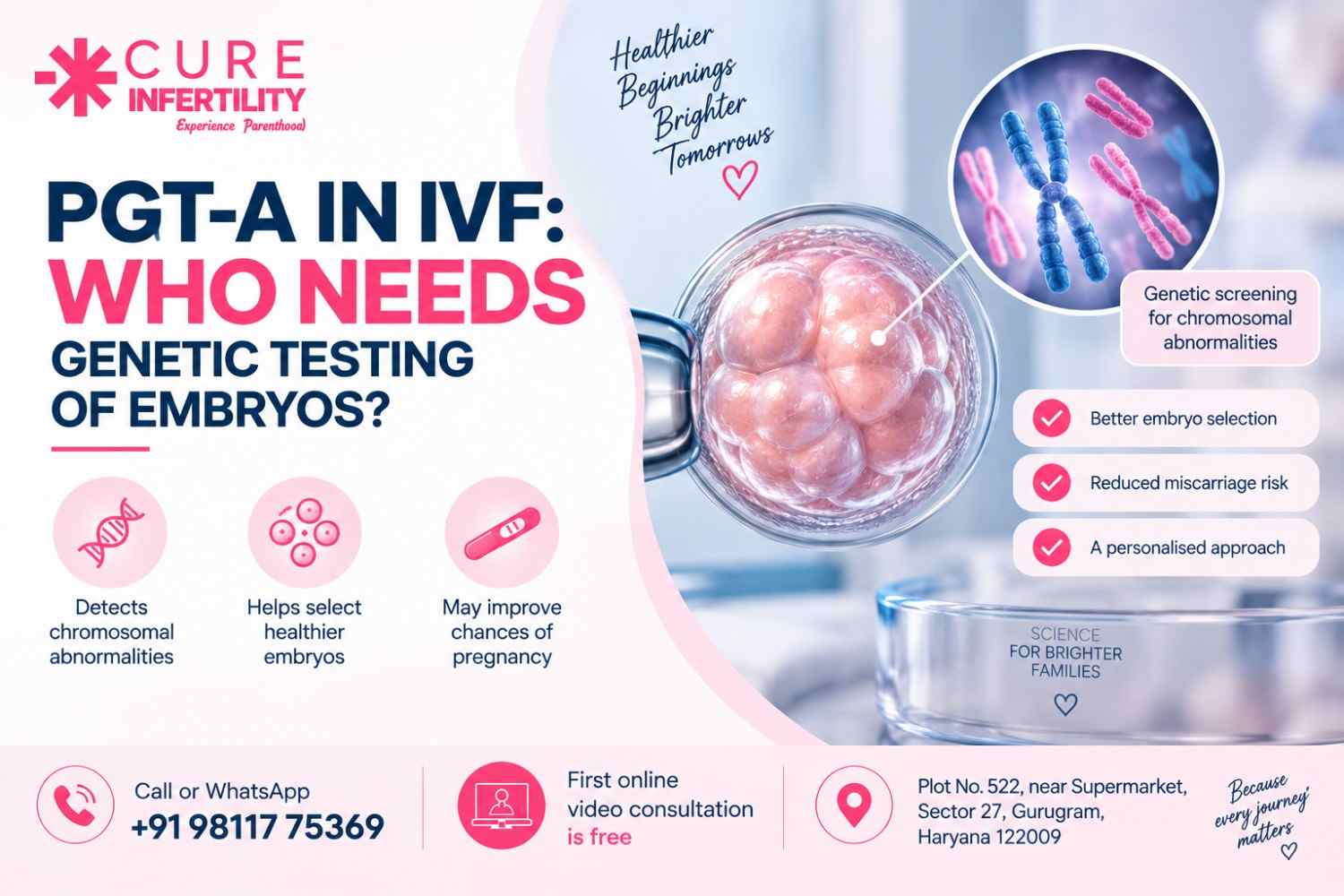
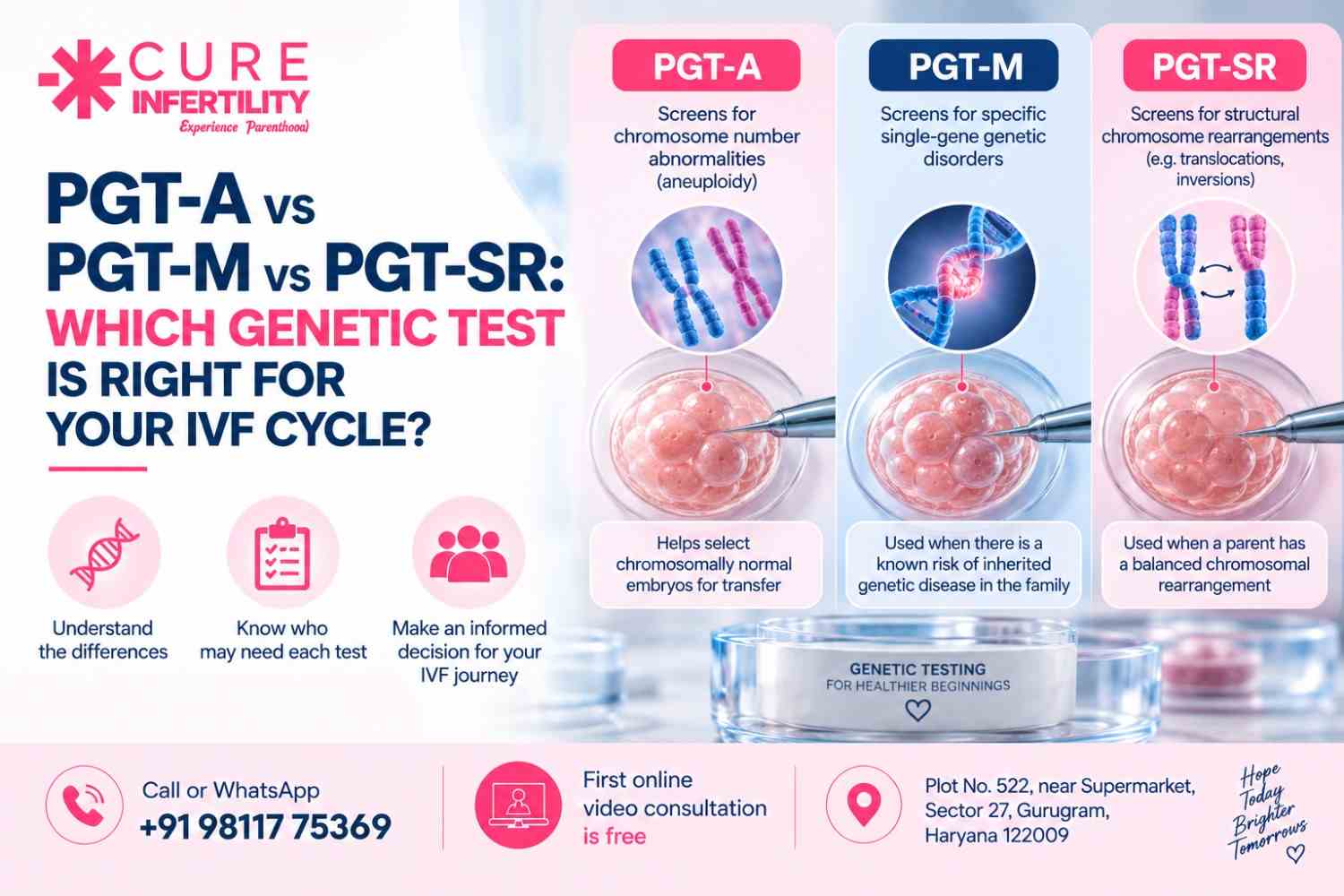
PGT-A asks: does this embryo have the right number of chromosomes? Ordered because of age or history, not family history.
PGT-M asks: does this embryo carry the specific inherited disease we already know runs in our family? Ordered because a mutation has been identified.
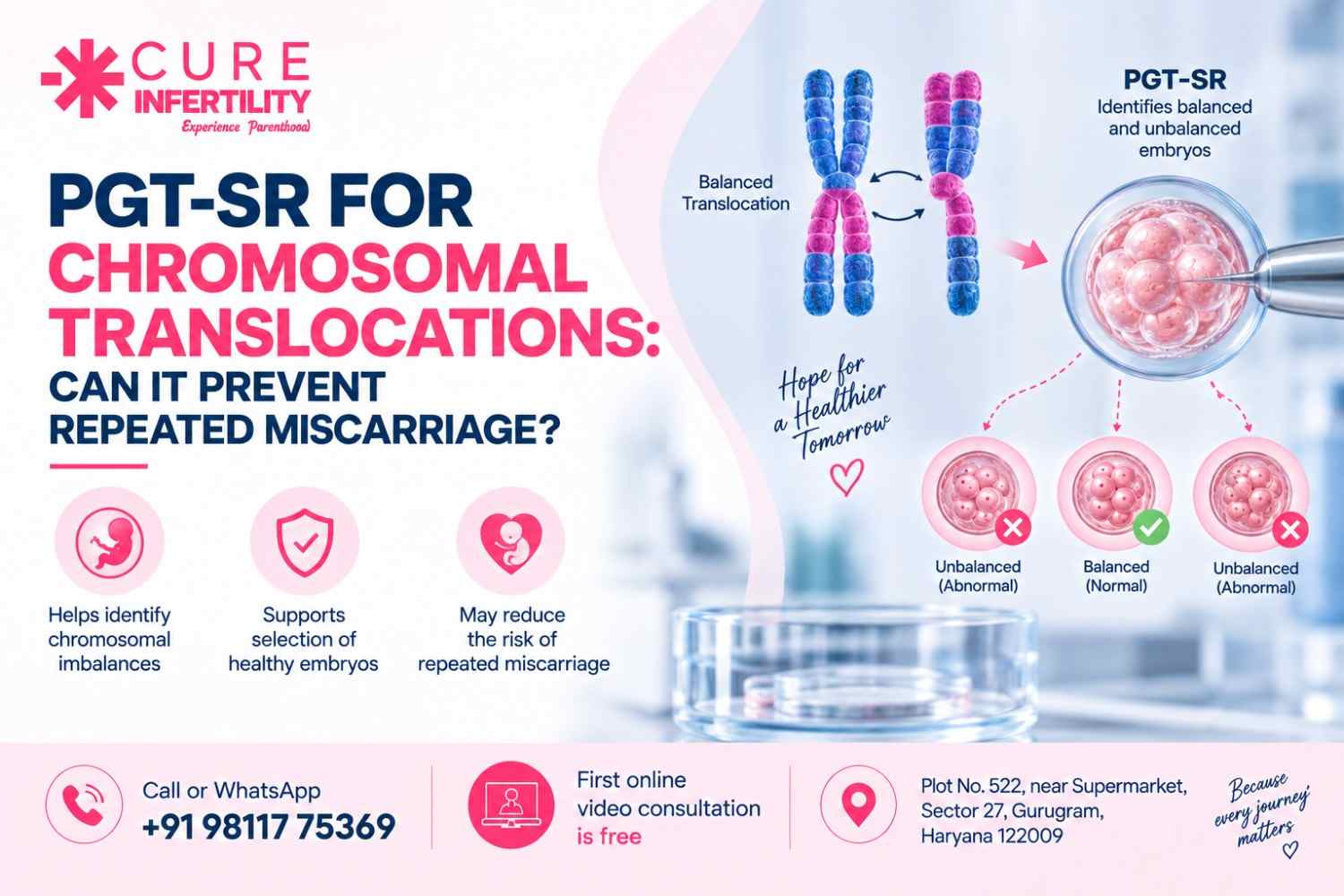
PGT-SR asks: has this embryo inherited an unbalanced version of a chromosome rearrangement one parent carries? Ordered because a karyotype found a translocation or inversion.
Everything else follows from that distinction.
Side by Side
| PGT-A | PGT-M | PGT-SR | |
|---|---|---|---|
| Full name | PGT for aneuploidy | PGT for monogenic disorders | PGT for structural rearrangements |
| What it looks for | Wrong number of chromosomes | A specific single-gene mutation | Unbalanced chromosome rearrangements |
| Why it is ordered | Maternal age, repeated failure, recurrent loss | Known inherited disease in the family | A balanced translocation or inversion found on karyotype |
| Family history needed | No | Yes, confirmed by genetic testing | Yes, confirmed by karyotype |
| Custom test built first | No, off the shelf | Yes, several weeks to months | Sometimes, depending on the rearrangement |
| Strength of evidence | Debated | Well established | Established for reducing loss, debated for live birth |
| Typical example | Woman aged 39 after two failed transfers | Both partners thalassaemia carriers | Four miscarriages, husband carries a reciprocal translocation |
Which Applies to You
| Your situation | Test usually relevant |
|---|---|
| Aged 38 or over, no family history | PGT-A, if enough embryos |
| Repeated implantation failure, uterus normal | PGT-A |
| Both partners carry thalassaemia | PGT-M |
| Both partners carry the same recessive condition | PGT-M |
| One partner has a dominant condition | PGT-M |
| Previous child with a diagnosed genetic disease | PGT-M |
| Balanced translocation on either karyotype | PGT-SR |
| Repeated miscarriage, karyotypes normal | Often none, investigate other causes |
| Young, first IVF cycle, no history | Usually none |
That last row matters. Not needing any of these tests is a legitimate and common answer.
Where the Evidence Actually Sits
This is the part that separates the three, and it is where most clinic pages blur the distinction.
PGT-M has the strongest case. Where a couple carries a known mutation for a serious disease, testing embryos for it is well established and highly accurate. Reported misdiagnosis rates in recent consortium data are under 0.1 percent. Nobody seriously disputes its role. Our article on PGT-M covers the conditions it can detect and the test development process.
PGT-SR sits in the middle. It reliably identifies unbalanced embryos and reduces the miscarriage rate per pregnancy. What it has not clearly been shown to do is increase the chance that a carrier couple eventually has a baby, since most get there without intervention. Our article on PGT-SR sets out that trade-off in full.
PGT-A is the genuinely contested one. It improves the success rate per embryo transfer, which is not the same as improving your chance of a live birth from the cycle overall. In younger women, large trials have not shown a convincing benefit in cumulative live birth rates. Its clearest value is at older ages and after repeated failure. Our article on PGT-A covers the debate properly.
If a centre presents all three as equally evidence-backed, that is a signal worth noticing.
What All Three Share
Whichever test applies, the cycle mechanics are identical.
You need a full IVF cycle with stimulation and egg retrieval. Fertilisation is by ICSI rather than conventional insemination, because stray sperm on the outside of the egg would contaminate the genetic sample. Embryos are grown to blastocyst, a few cells are biopsied from the outer layer that becomes the placenta, and embryos are frozen while results come back. Transfer always happens in a later frozen cycle.
All three also narrow your pool of transferable embryos, which is why egg numbers matter more in a tested cycle than an untested one. Age and ovarian reserve therefore drive the outcome substantially, as covered in our articles on IVF success rates by age and low AMH and pregnancy.
And none of them improve embryo quality. They select. They do not create.
Can They Be Combined?
Yes, and combinations are common.
PGT-M with PGT-A is frequently done together, so that embryos free of the family's genetic condition are also checked for chromosome number. This matters most where maternal age is higher, since an embryo can be free of thalassaemia and still be aneuploid.
PGT-SR with PGT-A is effectively built in on modern platforms, which report chromosome number alongside the rearrangement.
PGT-M with PGT-SR applies where a couple has both a known single-gene disease and a translocation, which is uncommon but does occur.
The practical caution with combining is that each additional filter removes more embryos. A couple with four blastocysts and two filters can easily end with none transferable. Discuss that scenario before the cycle, not after.
The Timeline Difference Nobody Mentions
This is the most common planning mistake.
PGT-A can be ordered essentially off the shelf. The cycle can start once you decide.
PGT-M requires a family-specific test to be designed and validated first, using blood samples from both partners and often from affected relatives. This takes several weeks and sometimes months. The IVF cycle should not start until it is ready.
PGT-SR may need a preliminary workup depending on the rearrangement and the platform used.
Couples who begin stimulation before the test is ready end up with frozen embryos and an unnecessary wait. Ask about the timeline at the first consultation.
Questions to Ask Before Consenting
- Which of these three tests is being recommended for me, and which specific finding justifies it?
- If it is PGT-A, what is my expected embryo number, and is that enough for selection to be meaningful?
- If it is PGT-M or PGT-SR, how long will test development take before the cycle can start?
- What happens if no transferable embryo is found?
- Is confirmatory prenatal testing recommended afterwards?
- What is the total additional cost, including freezing and a separate transfer cycle?
A clear answer tied to your own reports is a good sign. A recommendation that applies to every patient walking through the door is not.
The Honest Summary
PGT-M is the least controversial and the most clearly beneficial, for the specific couples who need it. PGT-SR reduces miscarriage in translocation carriers, though the effect on eventually having a baby is less clear. PGT-A is genuinely useful at older ages and after repeated failure, and adds little for young couples in a first cycle.
None of them is a general upgrade to IVF. Each answers a specific question, and the right one for you depends entirely on what your own testing has found.
You can read more on the PGT and IVF treatment pages, and see the full range of treatment options here.
You can book a free consultation with Dr. Rashmi Agrawal at the Sector 27, Gurugram clinic to review your reports and discuss which test, if any, applies to you, read more about her background and approach, or check the FAQ page.
FAQs
What is the difference between PGT-A, PGT-M and PGT-SR? PGT-A screens for the wrong number of chromosomes without reference to family history. PGT-M tests for a specific inherited single-gene disease known to run in the family. PGT-SR checks for unbalanced versions of a chromosome rearrangement carried by a parent.
Do I need all three tests? Almost never. Each has a distinct indication. Most couples need one or none. Combinations are used where two separate indications genuinely exist.
Which PGT test has the strongest evidence behind it? PGT-M, where a known disease-causing mutation exists, is the least disputed and the most accurate. PGT-A is the most debated, particularly in younger women.
Do all PGT tests require ICSI? Yes. Conventional fertilisation leaves sperm attached to the outside of the egg, which can contaminate the genetic sample, so ICSI is used in all PGT cycles.
Can I have a fresh embryo transfer with PGT? No. Results take time, so embryos are frozen while testing is carried out and transfer happens in a subsequent cycle.
How long does PGT delay my IVF cycle? PGT-A adds little upfront delay. PGT-M requires a custom test built before the cycle starts, taking weeks to months. PGT-SR may need a preliminary workup depending on the rearrangement.
Does PGT guarantee a healthy baby? No. Each test screens for what it was designed to detect and nothing else. Confirmatory prenatal testing is generally recommended, and no test covers every possible condition.
Is PGT worth the extra cost? It depends entirely on the indication. Where a clear one exists, it can avoid failed transfers, losses or the transmission of a serious disease. Where none exists, it adds cost without a corresponding benefit.
References
- ESHRE PGT Consortium. Good practice recommendations for the organisation of PGT. Human Reproduction Open, 2020. https://academic.oup.com/hropen/article/2020/3/hoaa021/5848302
- ESHRE PGT-SR/PGT-A Working Group. Good practice recommendations for the detection of structural and numerical chromosomal aberrations. Human Reproduction Open, 2020. https://pmc.ncbi.nlm.nih.gov/articles/PMC7257111
- ESHRE PGT-M Working Group. Good practice recommendations for the detection of monogenic disorders. Human Reproduction Open, 2020. https://academic.oup.com/hropen/article/2020/3/hoaa018/5848301