IVF Injections: Are They Painful? Side Effects and What to Expect
Learn about IVF injections, whether they are painful, common side effects, where they are given, and what to expect during an IVF treatment cycle.
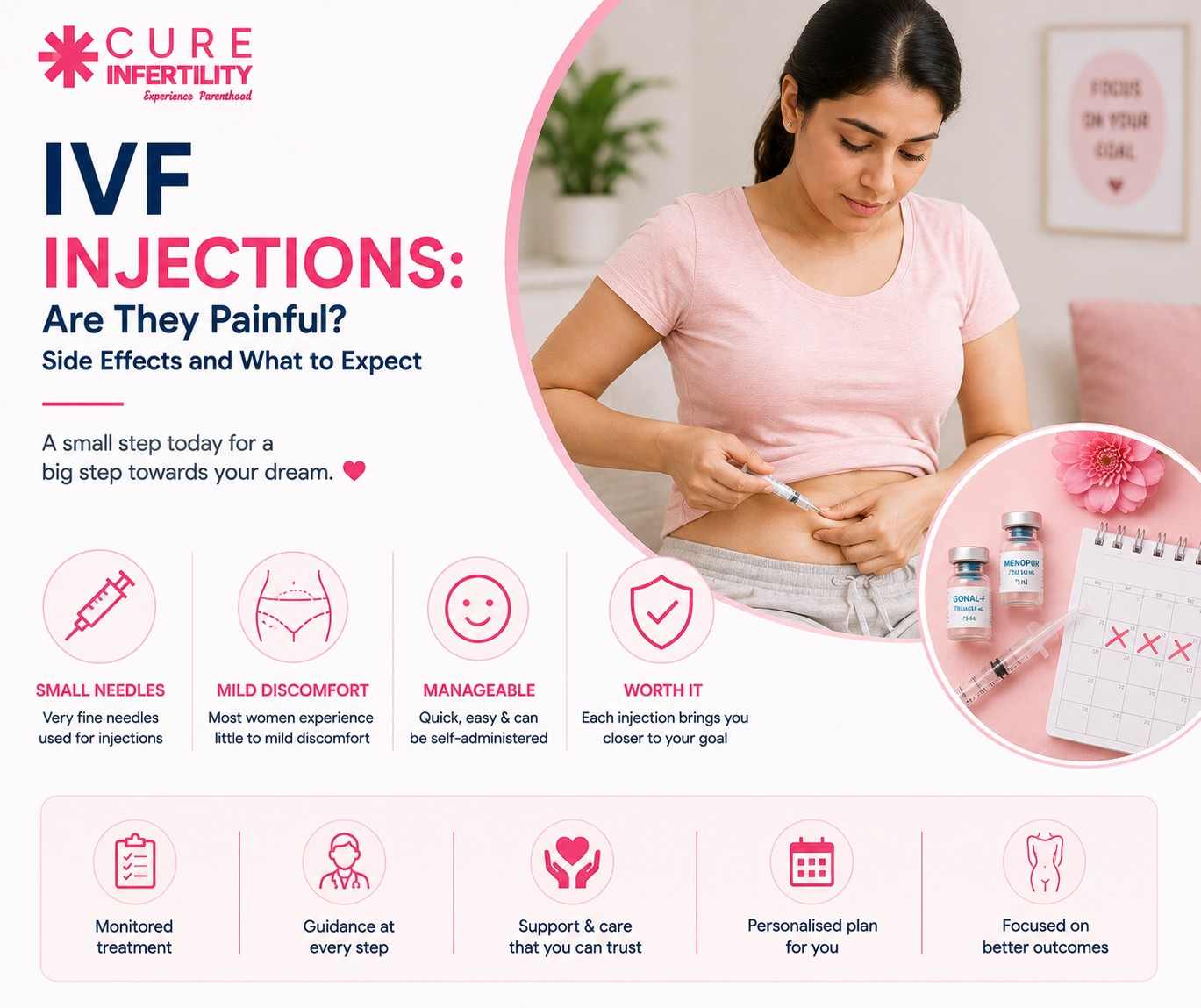
The injections are the part of IVF that most women dread before starting, and the part most say afterwards was easier than they expected. That gap between anticipation and reality is worth closing, because fear of needles delays treatment for people who would otherwise have started sooner. Here's what the injections actually feel like, what side effects to expect, and which ones matter.
Why Injections Are Needed at All
In a natural cycle, the body matures and releases a single egg. IVF needs multiple eggs, because attrition happens at every stage: not all eggs retrieved are mature, not all mature eggs fertilise, and not all fertilised eggs develop into viable embryos.
The medications have to be injected rather than taken as tablets because they are protein-based hormones. Stomach acid and digestive enzymes would break them down before they reached the bloodstream, so oral versions simply would not work.
The Types of Injections in an IVF Cycle
Stimulation injections (gonadotropins such as FSH and combined FSH/LH preparations) run for roughly 8 to 12 days and encourage multiple follicles to develop at once. These are subcutaneous, meaning they go into the fat layer just under the skin, usually in the abdomen or upper thigh, using a very fine short needle. Many come as pre-filled pens with a dial, which most women find considerably less intimidating than a syringe.
Suppression injections (GnRH antagonists or agonists) prevent your body from releasing the eggs early, before retrieval. These are also subcutaneous and are usually added partway through stimulation.
The trigger injection, given once, roughly 34 to 36 hours before retrieval, completes final egg maturation. Timing here is exact, and the instruction to take it at a specific hour is not flexible.
Progesterone support after retrieval prepares and maintains the uterine lining. This is often given as vaginal pessaries or gel rather than an injection. Where injectable progesterone in oil is used, it is intramuscular, given into the buttock with a longer needle, and this is the one most women find genuinely uncomfortable.
So Are They Actually Painful?
Honest answer: the subcutaneous injections, which are the overwhelming majority, are mild. Most women describe a brief sting or pinch lasting a second or two. The needles are very fine and very short. It is closer to a blood sugar prick than to a vaccination.
What tends to be more bothersome than the injection itself is the cumulative effect: mild bruising, small red marks, tenderness at the sites, and the psychological weight of doing this every day for a couple of weeks. The daily-ness wears on people more than the needle does.
Intramuscular progesterone is a different experience. The needle is longer, the oil is thick, and soreness afterwards is common. If your protocol includes it, ask whether vaginal progesterone is an option for you, because it often is and it is generally better tolerated.
Practical Ways to Make Them Easier
- Rotate injection sites rather than using the same spot, to reduce bruising and tenderness
- Let the medication reach room temperature before injecting, since cold solution stings more
- Apply ice for a minute beforehand to numb the area
- Inject slowly, since pushing too fast increases the sting
- Pinch the skin to lift the fat layer away from muscle for subcutaneous injections
- Have your partner do them if self-injecting is the difficult part, or vice versa if you'd rather control it yourself
- For intramuscular injections, warm the site beforehand and massage gently afterwards to help the oil disperse
- Set an alarm for each dose, particularly the trigger, where timing is critical
Anticipation is usually worse than the act. Most women report that after the first two or three, it becomes routine.
Common Side Effects During Stimulation
Most of these come from rising oestrogen levels as multiple follicles develop, and they resolve after the cycle ends.
- Bloating and abdominal fullness, the most common complaint, caused by enlarging ovaries
- Breast tenderness
- Mood changes, including irritability and emotional sensitivity
- Headaches
- Fatigue
- Injection site reactions: redness, bruising, mild itching
- Mild pelvic discomfort or heaviness, particularly in the later days of stimulation
- Nausea in some women
None of these are signs that something is going wrong. They are the expected consequence of the ovaries doing what the medication is asking them to do.
Ovarian Hyperstimulation Syndrome: The One to Watch
OHSS is the significant risk of stimulation, and it is worth understanding properly rather than vaguely fearing.
It occurs when the ovaries respond excessively, causing fluid to shift out of blood vessels into the abdomen. Mild forms are relatively common and manage themselves. Moderate and severe forms are much less common with modern protocols but need prompt medical attention.
Contact your clinic straight away if you experience rapid weight gain of more than 2 to 3 kg in a few days, severe or worsening abdominal pain, significant abdominal swelling, shortness of breath, persistent vomiting, or markedly reduced urine output.
Women with PCOS are at higher risk because they typically have a high antral follicle count and respond strongly to stimulation, which is why their protocols need careful adjustment. Our article on PCOS covers this in more detail. Modern approaches, including antagonist protocols, adjusted trigger medications and freeze-all strategies, have reduced the incidence of severe OHSS considerably.
What Injections Do Not Cause
A few worries come up repeatedly and deserve straight answers.
They do not "use up" your eggs faster or bring on early menopause. Each natural cycle recruits a cohort of follicles, and most of them are lost regardless. Stimulation rescues follicles from that cohort that would otherwise have been discarded. It does not draw on your future reserve.
Weight changes during stimulation are largely fluid retention and bloating, not fat gain, and they settle after the cycle.
Mood changes are hormonal and temporary. They are a real effect of the medication, not a personal failing or a sign you are not coping.
The Emotional Side, Which Is Usually Underestimated
The physical discomfort is manageable. The harder part for most people is the daily routine of injections colliding with work and normal life, the anxiety around each monitoring scan, and the emotional weight of the whole cycle. That is normal, and it is worth telling your clinical team about rather than carrying alone.
This matters more if you have been through unsuccessful cycles before, where each injection carries the memory of the last outcome. If you are in that position, our articles on what causes failed IVF and which tests to consider after repeated failure may help you go into the next cycle with a clearer plan rather than a repeat of the last one.
Injections in Other Treatments
If the prospect of full stimulation is what is putting you off, it is worth knowing that not every treatment involves this intensity. Ovulation induction and cycle monitoring often uses oral medication with few or no injections, and IUI cycles typically involve lighter stimulation than IVF. Which route is appropriate depends on your diagnosis, not on preference alone, but the assumption that fertility treatment automatically means weeks of injections is not accurate.
Egg freezing uses the same stimulation and injection protocol as IVF, so everything in this article applies equally there. Age matters to outcomes in both, as covered in our piece on IVF success rates by age.
You can see the full range of treatment options here.
Questions Worth Asking Before You Start
- How many days of injections should I expect on my protocol?
- Which medications am I on, and are any of them intramuscular?
- Can I use vaginal progesterone instead of injectable?
- What is my OHSS risk given my AMH and antral follicle count?
- Who do I contact out of hours if something concerns me?
- Can someone demonstrate the injection technique before I go home?
A proper teaching session before you start makes a large difference to how the first few days go. Ask for one if it is not offered.
You can book a free consultation with Dr. Rashmi Agrawal at the Sector 27, Gurugram clinic, read more about her background and approach, or check the FAQ page.
FAQs
How painful are IVF injections?
Most are subcutaneous, given with a very fine short needle, and feel like a brief pinch or sting. The daily repetition and mild bruising tend to bother women more than the injection itself. Intramuscular progesterone, where used, is the more uncomfortable one.
How many injections are needed in one IVF cycle?
It varies by protocol, but typically around 10 to 14 days of daily injections during stimulation, sometimes with more than one injection per day, plus a single trigger shot before retrieval.
Can I give the injections myself at home?
Yes, and most women do. Clinics provide a teaching session first. Many stimulation medications come as pre-filled pens, which are simpler to use than syringes.
Do IVF injections cause weight gain?
Any weight change during stimulation is mostly fluid retention and bloating from enlarged ovaries, not fat gain, and it typically settles within a few weeks of the cycle ending.
Will IVF injections bring on early menopause?
No. Stimulation works on the cohort of follicles your body had already recruited that month, most of which would have been lost anyway. It does not deplete your future ovarian reserve.
What should I do if I miss an injection or take it late?
Contact your clinic immediately rather than adjusting the dose yourself. Timing matters, particularly for the trigger injection, and your team will advise on what to do.
Do the side effects go away after the cycle?
Yes. Bloating, mood changes and breast tenderness resolve after the cycle ends, usually within a couple of weeks. Persistent or worsening symptoms, especially severe abdominal pain or breathlessness, need urgent clinical review.
Medically reviewed
Reviewed by Dr. Rashmi Agrawal — MBBS (Gold Medalist), MS OBGYN, FNB Reproductive Medicine. This article is general information, not a substitute for a consultation about your own reports.
Book Consultation