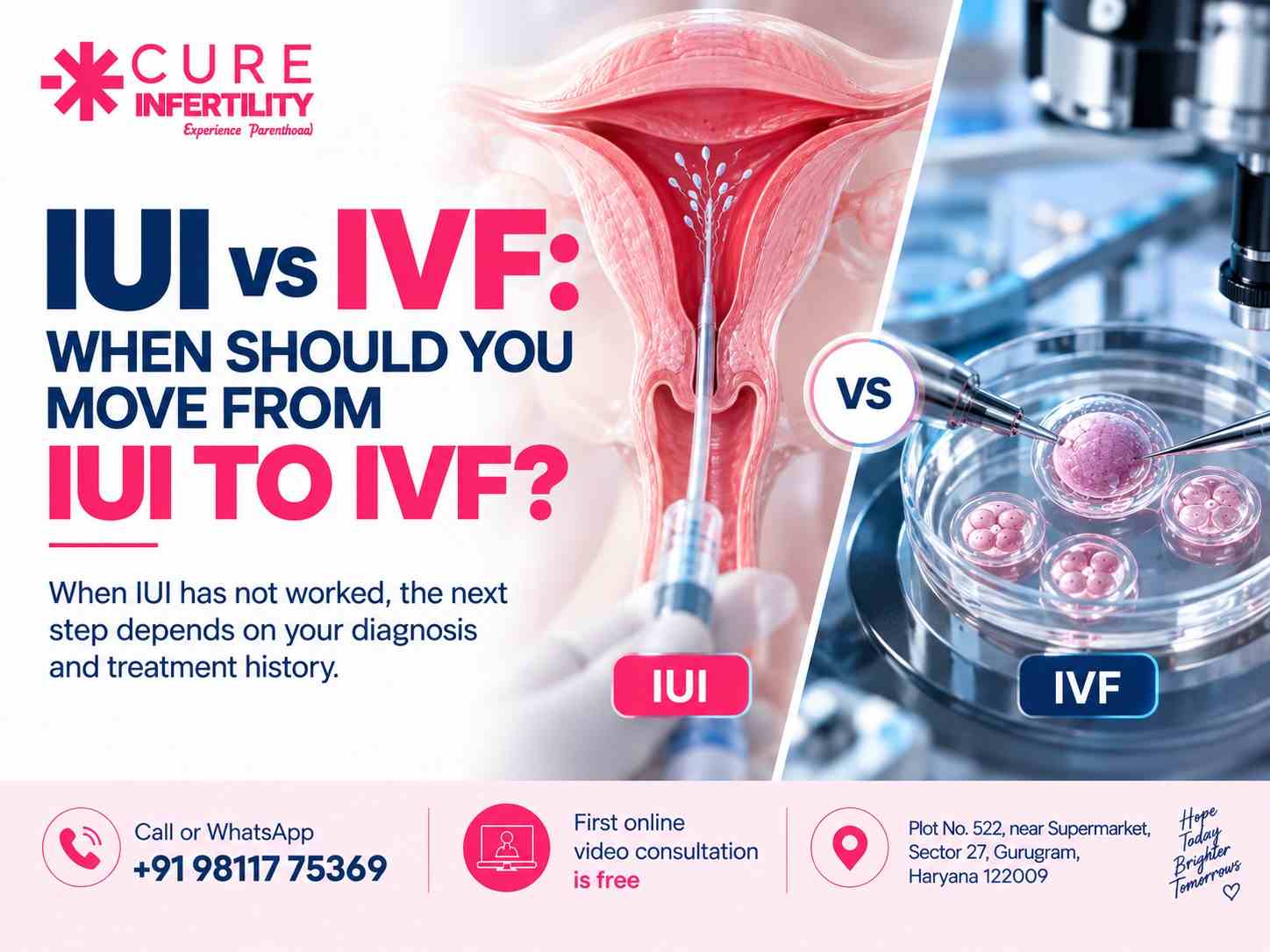
The mistake couples make with IUI is almost never doing it. It is doing it for too long. IUI is cheap, simple and low-risk, which makes it easy to keep repeating, and every repeated cycle costs a month of a resource that does not come back. The opposite mistake also happens: being pushed to IVF when IUI would have worked. Here is how to tell which side of that line you are on.
What Each Treatment Actually Does
IUI places washed, concentrated sperm directly into the uterus around ovulation. It shortens the journey and improves sperm concentration at the right moment. Everything else still has to happen naturally: the egg must be released, picked up by the tube, fertilised inside the tube, and the embryo must travel to the uterus and implant.
IVF takes the eggs out. Fertilisation happens in the laboratory, embryos are cultured and watched, and one is placed directly into the uterus. Ovulation, tubal pickup, fertilisation and transport are all bypassed.
That difference explains everything about when each one works. IUI assists a system that functions. IVF replaces the parts that do not.
Side by Side
| IUI | IVF | |
|---|---|---|
| What it bypasses | Cervix, sperm journey | Ovulation, tubes, fertilisation, transport |
| Fertilisation happens | Inside the fallopian tube | In the laboratory |
| Open fallopian tubes needed | Yes, at least one | No |
| Injections | Few or none, often oral tablets | Daily, roughly 10 to 14 days |
| Clinic visits per cycle | 2 to 4 | 5 to 7 |
| Anaesthesia | None | Sedation for egg retrieval |
| Success per cycle | Roughly 10 to 15 percent in suitable couples | Substantially higher, driven by age |
| Cost per cycle | Low | High |
| Information gained if it fails | Almost none | Egg number, quality, fertilisation, embryo development |
| Diagnostic value | Minimal | Considerable |
The last two rows are underrated. A failed IUI tells you almost nothing about why. A failed IVF cycle tells you a great deal, which is why couples who have spent a year on IUI often learn more from one IVF cycle than from all the IUIs combined.
When IUI Is the Right Starting Point
IUI is genuinely appropriate, and skipping it is a real mistake in these situations:
- Unexplained infertility in a younger woman with good ovarian reserve
- Mild male factor, where post-wash motile sperm counts remain adequate
- Ovulatory disorders, particularly PCOS, where the core problem is that an egg is not being released reliably. Ovulation induction and cycle monitoring addresses this directly, and our article on PCOS covers why this group often does not need IVF at all
- Cervical factor, where sperm cannot pass the cervix effectively
- Sexual or ejaculatory difficulties preventing intercourse at the right time
- Donor sperm use
The common requirement across all of these is at least one open fallopian tube and reasonable sperm parameters. Without both, IUI is not assisting anything.
When to Skip IUI Entirely
Going straight to IVF is the correct decision, not an upsell, in these cases:
| Situation | Why IUI will not work |
|---|---|
| Both fallopian tubes blocked | Fertilisation cannot occur |
| Hydrosalpinx | Fluid is toxic to embryos and reduces success |
| Severe male factor | Too few functional sperm reach the egg |
| Azoospermia | No sperm in the ejaculate to insert |
| Significantly low ovarian reserve with advancing age | Time is the constraint, not the mechanism |
| Moderate to severe endometriosis | Pelvic anatomy and egg pickup are affected |
| Woman aged 40 or over | Per-cycle IUI success is too low to justify the delay |
| Genetic testing of embryos needed | Requires embryos in the laboratory |
Our articles on blocked fallopian tubes and low sperm count cover two of these in detail. Where male factor is severe, ICSI alongside IVF is usually required, as explained in our article on IVF vs ICSI.
How Many IUI Cycles Before Moving On
This is the question the article exists to answer, and there is a reasonably clear evidence-based answer.
ASRM guidance recommends that couples with unexplained infertility undergo a course of typically three or four cycles of ovarian stimulation with oral medication plus IUI, and that those unsuccessful after that move to IVF rather than escalating to injectable gonadotropins with IUI.
Three or four is the number to hold in your head. The reasoning behind it is that the large majority of IUI successes happen in the first three cycles. Beyond the fourth, per-cycle success drops for most couples, and cumulative gains become small relative to the time spent.
That figure is a starting rule, not a fixed rule. It shifts:
Move sooner than three or four cycles if you are 38 or over, if ovarian reserve is declining, if a new problem has been identified during monitoring, or if response to stimulation has been poor.
It may be reasonable to continue past four if you are under 32 with good reserve, if the diagnosis is cervical factor or donor sperm use, where cumulative rates continue climbing over more cycles, and if there is no time pressure.
Move immediately if any of the conditions in the previous section emerges.
The Arithmetic Nobody Does
Here is the calculation that changes most couples' thinking.
Six IUI cycles is six months, minimum, and usually closer to eight once cancelled cycles and gaps are counted. If those cycles run from age 37 to age 38, you have spent the most valuable remaining months of your ovarian reserve on a treatment with roughly a one in eight chance per attempt.
The cost comparison is similar. IUI is cheap per cycle, but six cycles of IUI plus the IVF you eventually need costs more than starting IVF earlier, and it arrives at IVF with older eggs.
This is why age dominates the decision. Under 33, time is cheap and IUI is a sensible thing to spend it on. Over 37, time is the scarcest thing you have, and spending eight months on a low-yield treatment is an expensive decision disguised as a cheap one. Our article on IVF success rates by age sets out how steeply that curve moves.
Before You Start Either One
A decision between IUI and IVF is only as good as the workup behind it. Before starting IUI, you should have:
- Tubal assessment, by HSG or laparoscopy. Starting IUI without knowing whether the tubes are open is indefensible, and it still happens
- A current semen analysis, including post-wash motile count, not a report from two years ago
- Ovarian reserve testing, AMH and antral follicle count. Our article on the AMH test explains what those results mean and, importantly, what they do not
- Confirmation of ovulation
- Thyroid function and prolactin
- Assessment of the uterine cavity where indicated, sometimes through hysteroscopy
If IUI has been recommended without these, ask why.
Questions Worth Asking
- Are both my tubes open, and what test confirmed that?
- What is my partner's post-wash motile sperm count?
- Given my age and reserve, what per-cycle chance are we working with?
- How many cycles are we planning before we review, and what would make us stop earlier?
- If we move to IVF after this, how much time will have passed?
That fourth question matters most. A plan with a defined stopping point is a plan. Repeating IUI until someone feels like stopping is not.
Both Errors Are Real
It is worth being even-handed here, because both mistakes cause harm.
Being kept on IUI too long wastes ovarian reserve and delays effective treatment. Being pushed to IVF when IUI would have worked costs money, physical demand and risk that was not necessary. A woman of 29 with PCOS and open tubes whose partner has normal sperm should not be starting with IVF.
The honest position is that the right treatment follows from the diagnosis and the age, and that the plan should include a defined review point from the outset.
You can see the full range of treatment options here.
You can book a free consultation with Dr. Rashmi Agrawal at the Sector 27, Gurugram clinic to review your reports and agree a plan with a clear stopping point, read more about her background and approach, or check the FAQ page.
FAQs
How many IUI cycles should I try before IVF?
Guidance for unexplained infertility recommends typically three or four cycles of stimulated IUI before moving to IVF. Most IUI successes occur in the first three cycles, so continuing well beyond four rarely changes the outcome.
Is IVF better than IUI?
IVF has considerably higher success per cycle, but it is not better for everyone. For younger couples with open tubes, normal sperm and unexplained or ovulatory infertility, IUI is a reasonable and much less demanding first step.
Can I do IUI with blocked tubes?
No, not with both blocked. Fertilisation happens inside the tube during IUI, so at least one open tube is essential. With one open tube, IUI may still be considered.
Does IUI work with low sperm count?
Only with mild reduction, where post-wash motile counts remain adequate. With significant male factor, IUI success falls sharply and IVF with ICSI is the appropriate route.
Should I skip IUI if I am over 38?
Often yes. Per-cycle IUI success is low at this age, and several months spent on it costs ovarian reserve that cannot be recovered. This is a discussion to have explicitly rather than by default.
Is IUI cheaper than IVF overall?
Per cycle, yes. Across a full treatment journey, not necessarily. Several IUI cycles followed by the IVF you eventually needed can cost more than starting IVF sooner, and arrives there with older eggs.
Does a failed IUI tell us anything useful?
Very little, which is one of its real drawbacks. A failed IVF cycle by contrast reveals egg numbers, egg quality, fertilisation and embryo development, all of which guide what happens next.
Can IUI be done without injections?
Often yes. Many IUI cycles use oral medication such as letrozole or clomiphene rather than injectable stimulation, which is one of the reasons IUI is far less demanding than IVF.
References
- Practice Committee of the American Society for Reproductive Medicine. Evidence-based treatments for couples with unexplained infertility: a guideline (2020). https://www.asrm.org/practice-guidance/practice-committee-documents/evidence-based-treatments-for-couples-with-unexplained-infertility-a-guideline-2020/
- Should couples with unexplained infertility have three to six cycles of intrauterine insemination with ovarian stimulation or in vitro fertilization as first-line treatment? Fertility and Sterility. https://www.fertstert.org/article/S0015-0282(20)32543-7/fulltext
- Pregnancy predictors after intrauterine insemination in cases of unexplained infertility: a prospective study. https://www.ncbi.nlm.nih.gov/pmc/articles/PMC5050366/