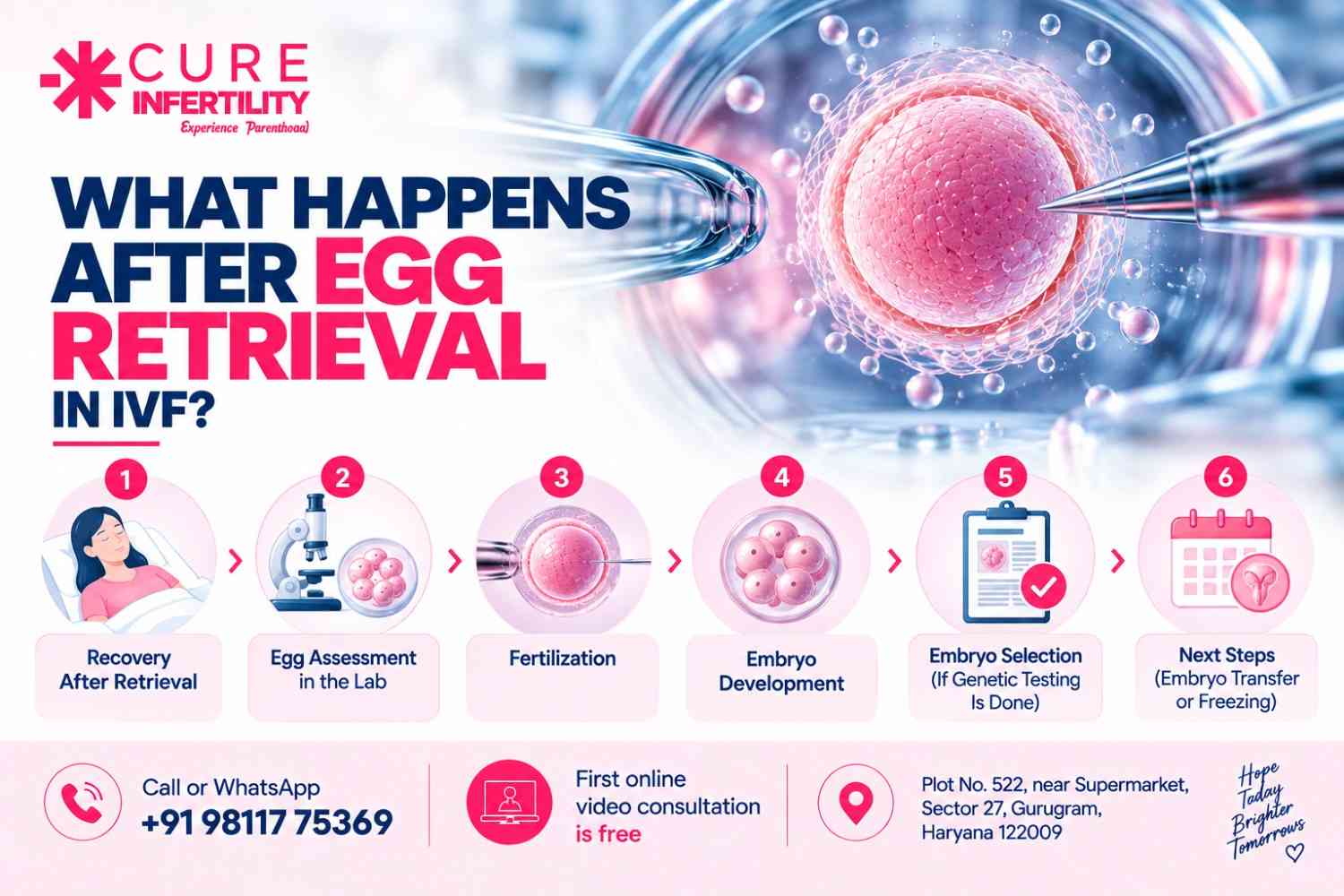
Egg retrieval feels like the finish line. It is actually the handover. From the moment your eggs leave theatre, the work moves to the laboratory and you lose all visibility over it, which is why the days after retrieval are the most anxious part of IVF for most couples. This article walks through what is happening to your eggs and embryos on each of those days, what the phone calls mean, and why the numbers drop at every stage.
For what leads up to this point, our article on IVF injections covers the stimulation phase.
Day 0: Retrieval Day
Your eggs are taken to the laboratory within minutes of retrieval and examined under a microscope.
The first thing the embryologist does is count and assess maturity. Only mature eggs, at the stage called metaphase II, can be fertilised. Immature eggs cannot be used, and a proportion of every retrieval is immature. This is normal biology, not a mistake.
This is why the number you are told in recovery is not the number that matters. You will usually be told how many eggs were collected. The useful number, how many were mature, often comes later the same day or the next morning, and it is always lower. Knowing this in advance prevents an unnecessary afternoon of panic.
Fertilisation happens on the same day, within hours. Either conventional insemination, where eggs and prepared sperm are placed together, or ICSI, where a single sperm is injected into each mature egg. Our article on IVF vs ICSI explains when each is appropriate.
Day 1: The Fertilisation Report
This is the first real call, usually the morning after retrieval.
Roughly 16 to 18 hours after insemination, the embryologist checks each egg for two pronuclei, one from the egg and one from the sperm. Two pronuclei means normal fertilisation. This is the stage called 2PN.
Some eggs fail to fertilise. Some fertilise abnormally, with one or three pronuclei, and those cannot be used. A fertilisation rate well below expectation is itself diagnostic information, pointing toward egg quality, sperm function or, rarely, a specific fertilisation defect.
What you hear on this call: how many mature eggs fertilised normally. That number is your starting pool of embryos, and it is lower again than the mature egg count.
Days 2 and 3: Cleavage Stage
The embryo now divides. By day 2 it is typically two to four cells, and by day 3 around six to eight cells.
The embryologist watches the rate of division and the evenness of the cells. Embryos that divide too slowly, too quickly, or very unevenly are less likely to progress. Fragmentation, small cellular debris between cells, is also noted.
Most clinics do not call every day at this stage. Some give a day 3 update. The absence of a call is not bad news, it is just that nothing decision-relevant has happened yet.
An important point: everything so far has run on instructions stored in the egg. The embryo's own genome has not yet taken over.
Day 4: The Quiet Day, and the Real Test
Around day 3 to 4, the embryonic genome activates and the embryo begins running on its own genetic instructions. This is the handover from maternal to embryonic control, and it is where a large share of embryos stop.
By day 4 the embryo should be a morula, a compacted ball of cells. Many clinics do not report on day 4 at all.
This is the single most important thing to understand about the attrition you are about to be told about. An embryo can look perfect on day 3 and arrest on day 4 or 5, because that is the point at which its own chromosomes have to do the work. Chromosomally abnormal embryos frequently fail precisely here. Nothing was done wrong in the laboratory.
Days 5 and 6: Blastocyst Stage
A blastocyst has two distinct cell populations: the inner cell mass, which becomes the baby, and the trophectoderm, the outer layer that becomes the placenta. It also has a fluid-filled cavity and has usually begun to expand.
Grading at this stage assesses three things: how expanded the blastocyst is, the quality of the inner cell mass, and the quality of the trophectoderm. You may be given a grade like 4AA or 3BB. Higher expansion and better cell grades correlate with better outcomes, but grading assesses appearance only.
Grading cannot see chromosomes. A perfectly graded blastocyst can be chromosomally abnormal, and this is the most common reason a good-looking embryo fails to implant. Only PGT-A can assess that, and whether it is appropriate for you depends on your age and history.
Some embryos reach blastocyst on day 5, others on day 6. Day 6 blastocysts are usable, with slightly lower implantation rates than day 5 on average.
Why the Numbers Fall So Sharply
Here is the sequence that catches couples off guard. Attrition happens at every single step:
- Eggs collected, of which only some are mature
- Mature eggs, of which only some fertilise normally
- Fertilised eggs, of which only some divide well through day 3
- Day 3 embryos, of which only some reach blastocyst
- Blastocysts, of which only some are chromosomally normal
- Chromosomally normal blastocysts, of which only some implant
Fifteen eggs retrieved does not mean fifteen chances. It is entirely normal for fifteen eggs to become twelve mature, nine fertilised, and three or four usable blastocysts. That is not a failed cycle. That is the expected funnel.
If nobody has explained this shape to you before retrieval, ask for it to be explained at your next consultation, because the alternative is interpreting normal attrition as disaster.
Fresh Transfer or Freeze All?
One of two things happens next.
Fresh transfer, usually on day 5, places an embryo into the uterus in the same cycle as the retrieval.
Freeze all, where every viable blastocyst is vitrified and transfer happens in a later cycle.
The freeze-all approach has become much more common, for several reasons: it avoids transferring into a uterus affected by high hormone levels from stimulation, it is necessary when there is any OHSS risk, it is mandatory if genetic testing is being done, it allows the lining to be prepared properly in its own cycle, and modern vitrification means frozen embryos survive extremely well.
On the evidence, a large randomised trial in ovulatory women undergoing IVF found that frozen single-embryo transfer resulted in a modestly higher live birth rate than fresh transfer. Other work comparing cumulative live birth rates across fresh and vitrified cycles has found the two approaches broadly comparable overall. The honest summary is that freeze-all is at least as good as fresh in most situations and clearly better in specific ones, which is why it is now the default at many centres rather than a fallback.
Where there is any sign of ovarian hyperstimulation, freezing all embryos is not a preference, it is the correct clinical decision.
If No Embryo Is Available to Transfer
This happens, and it deserves naming rather than glossing over.
A cycle can end with no viable blastocyst: total fertilisation failure, all embryos arresting before day 5, or no embryo surviving to a transferable stage. It is devastating, and it is also informative in a way that a failed transfer is not.
A cycle that ends this way tells you something a failed IUI never would. Total fertilisation failure points toward sperm function or a fertilisation defect, and often indicates ICSI, or a different approach to sperm selection, next time. Embryos arresting consistently around day 4 to 5 points toward egg or embryo quality. Very few mature eggs from an adequate follicle count points toward the stimulation protocol or trigger timing.
What should happen afterwards is a proper review of exactly where the cycle stopped, and a protocol change based on it. Our article on repeated IVF failure covers that review in detail. Repeating an identical cycle after this outcome is the thing to push back on.
How You Will Feel in These Days
Physically, bloating often peaks one to three days after retrieval rather than immediately, which surprises people. Cramping and light spotting are normal. Most women feel reasonably normal within two to three days, longer after a large retrieval.
Contact the clinic urgently for rapid weight gain over a few days, severe or worsening abdominal pain, significant swelling, breathlessness, persistent vomiting or markedly reduced urine output. These can indicate ovarian hyperstimulation syndrome.
Emotionally, this is the stretch with the least control and the most waiting. You cannot influence what happens in the laboratory, and each call delivers a smaller number than the last. That is not things going wrong. It is the funnel working as it always does.
Questions Worth Asking Before Retrieval
Ask these in advance, not on the day:
- How many eggs were mature, not just collected?
- What was the fertilisation rate, and was it as expected?
- How many embryos are developing well at day 3?
- Are we planning a fresh transfer or freeze all, and why?
- On which days will I be called, and who calls if there is bad news?
- If no blastocyst develops, what would we change next cycle?
That last question is the one that matters most, and the one least often asked.
You can read more on the IVF treatment page and see the full range of treatment options here.
You can book a free consultation with Dr. Rashmi Agrawal at the Sector 27, Gurugram clinic to review a previous cycle's laboratory report in detail, read more about her background and approach, or check the FAQ page.
FAQs
How long after egg retrieval is embryo transfer?
With a fresh transfer, usually five days later at blastocyst stage. With a freeze-all approach, embryos are vitrified and transfer happens in a subsequent cycle, typically a few weeks to a couple of months later.
Why were fewer eggs fertilised than retrieved?
Only mature eggs can be fertilised, and a proportion of every retrieval is immature. Of the mature ones, some fail to fertilise or fertilise abnormally. A drop at this stage is expected.
What does 2PN mean on my report?
Two pronuclei, one contributed by the egg and one by the sperm, confirmed roughly 16 to 18 hours after insemination. It is the marker of normal fertilisation.
Is a day 6 blastocyst worse than a day 5?
Day 6 blastocysts are usable and result in healthy pregnancies. On average their implantation rates are slightly lower than day 5, but they are not discarded for timing alone.
Why did my embryos stop growing on day 4 or 5?
That is when the embryo switches to running on its own genome. Chromosomally abnormal embryos commonly arrest at exactly that point, which is biology rather than a laboratory error.
Does a high embryo grade mean a healthy embryo?
Not necessarily. Grading assesses appearance, not chromosomes. A top-graded blastocyst can still be chromosomally abnormal, which is the most common reason a good-looking embryo fails to implant.
Is frozen transfer better than fresh?
Freeze-all is at least as good as fresh in most situations and clearly preferable in specific ones, including any OHSS risk and whenever genetic testing is planned. It is now the default approach at many centres.
What if I have no embryos to transfer?
It is a difficult outcome but an informative one. Where the cycle stopped points toward what to change, whether that is the fertilisation method, the stimulation protocol or trigger timing. The next cycle should not be a repeat of the same approach.
References
- Chen ZJ, et al. Transfer of fresh versus frozen embryos in ovulatory women. New England Journal of Medicine. https://www.nejm.org/doi/full/10.1056/NEJMoa1705334
- Cumulative live birth rates after fresh and vitrified cleavage-stage versus blastocyst-stage embryo transfer in the first treatment cycle. Human Reproduction. https://academic.oup.com/humrep/article/31/11/2442/2274323